
Proper control of energy use is of utmost importance with regard to industrial and commercial activities. One of them is a power factor that enhances the energy efficiency of equipment and the extent of line losses. This PowerPoint presentation will discuss line losses as a result of low power factor – its operation, consequences, and how to alleviate them. This is what industries require in order to improve on their energy efficiency, operational costs and electrical system performance.
What is Power Factor?
Power Factor (PF) is defined as the ratio of the real power (kW) to the apparent power (kVA) of the electrical system. It indicates the efficiency with which electric power is utilized. The best power factor is one (1) or its equivalent a hundred percent, meaning all the power provided is used productively. A power factor lower than 1 means not all the electric energy consumed is productive with some ‘going to waste’ in so called passive activities.
Power factor = Real Power (kW) / Apparent Power (kVA)
The reason that the power factor is usually less than one in actual systems is mainly due to reactive loads, including electric motors, transformers and light ballast which introduces a phase difference between voltage and current where it is caused by inductive loads. This causes a drop in the power factor and thus more apparent power has to be taken from the source otherwise the system would have poles.
Understanding Line Losses in Electrical Systems
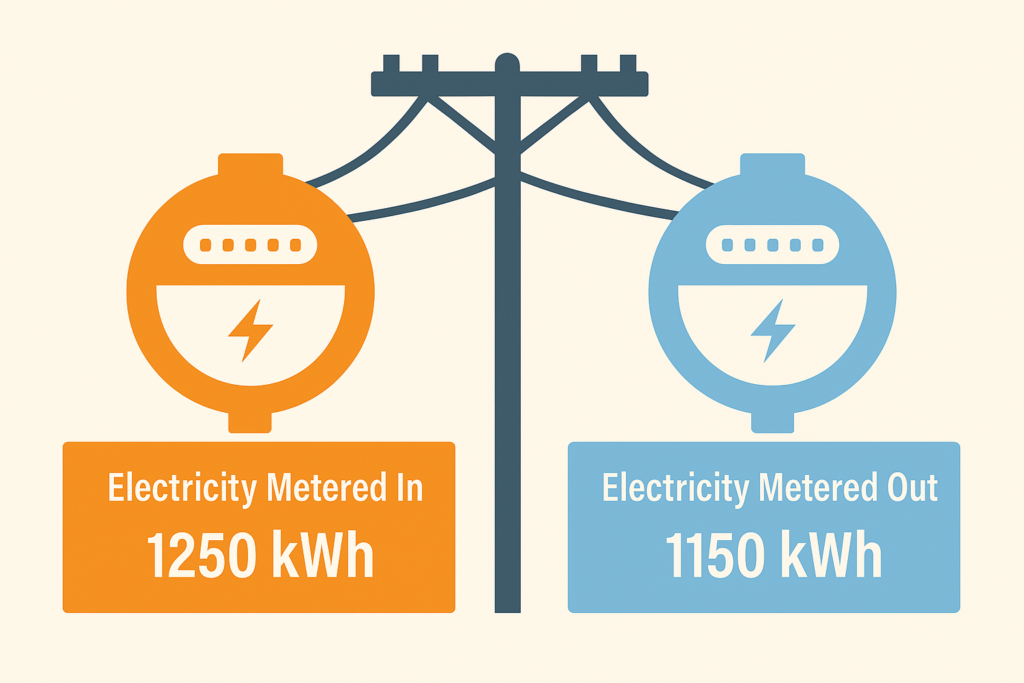
Line losses are described as the electrical energy removed from electrical supply wires as heat because of electrical resistance to the wires. These losses are directly proportional to the square of the current that is passing through the conductors in which higher current will mean higher losses.
The two primary types of losses are:
- Copper losses (I²R losses) – Caused by the flow of current through the resistance of conductors (transmission lines).
- Iron losses – Occur in transformers due to hysteresis and eddy currents.
While both types contribute to overall system inefficiencies, copper losses (I²R losses) are particularly relevant when discussing power factor and its effect on line losses.
How Does A Low Power Factor Cause A Higher Percentage Of Line Losses?
Lines with a low power factor utilize a larger amount of current in the system even when a given real power is being considered. The line losses are proportional to the current in square (I²) as a result; therefore, a little increase in the current has a significant impact in increasing energy losses.
For instance, we take a power system with a1power factor of 0.7. The efficiency of the system commences at 1, however, to ensure the same real power is supplied, the current being drawn will have to be more that this higher current makes the I²R losses worse. This leads to.
- Increased energy waste thereby lowering system performance efficiency due to heat wastage.
- Voltage drop- too much current at the transmission line may cause too much drop in the voltage across the length of this transmission line and this will affect the set requirements.
- Overloaded equipment – Electrical instruments like heaters and cables, and electrical parts like transformers are made to switch too much current than necessary exposing them to wear and overheating soil and eventually quitting altogether.
The Relationship Between Current and Power Factor
The current in a circuit has a dependency on the power factor. In a configuration with inductive loads, current lags behind the voltage thereby executing a phase shift. The greater the phase shift, the lower the power factor, and the more the current that has to be supplied in order to produce the same amount of real power.
For example:
• Power factor 1 means the system is running at the most optimum state where there is no difference between the current and voltage
• At 0.7 power factor and in an attempt to get the same real power, the system has to provide more current (nearly additional 43 percent) thus bringing in more line losses because of a higher I²R effect.
That is why when power factor is improved, it means the amount of current that is pulled from the supply gets reduced by that much, leading to lower line losses.
Determining Losses In Terms of Outage in Line Power Factor
The formula for calculating copper losses (line losses) in a system is given by:
Line losses (W) = I² × R
Where:
- I = Current flowing through the conductor
- R = Resistance of the conductor
Since current (I) is inversely related to power factor (PF), we can substitute I in terms of real power (P), voltage (V), and power factor (PF) as:
I = P / (V × PF)
Thus, the formula for line losses in terms of power factor becomes:
Line losses = [P² × R] / [V² × PF²]
From this equation, it’s evident that as the power factor decreases, the losses increase exponentially (since PF is squared in the denominator). For instance, a reduction in power factor from 1 to 0.7 would more than double the line losses.
Example 1: Industrial Motor System
Consider a motor drawing 100 kW of real power at a power factor of 0.8 and operating at 400V. The line resistance is 0.05 ohms.
- Current drawn: I = P / (V × PF) = 100,000 / (400 × 0.8) = 312.5 A
- Line losses: Losses = I² × R = 312.5² × 0.05 = 4,882 W (4.88 kW)
Now, if the power factor drops to 0.6:
- New current: I = 100,000 / (400 × 0.6) = 416.67 A
- New line losses: Losses = 416.67² × 0.05 = 8,680 W (8.68 kW)
In this case, a drop in power factor from 0.8 to 0.6 leads to an 80% increase in line losses!
Example 2: Commercial Lighting System
A lighting system consumes 50 kW at a power factor of 0.9 with a line resistance of 0.1 ohms.
- Current drawn: I = 50,000 / (400 × 0.9) = 138.89 A
- Line losses: Losses = 138.89² × 0.1 = 1,929 W (1.93 kW)
If the power factor drops to 0.7:
- New current: I = 50,000 / (400 × 0.7) = 178.57 A
- New line losses: Losses = 178.57² × 0.1 = 3,189 W (3.19 kW)
Here, the drop in power factor results in a 65% increase in line losses.
Negative Impacts of Low Power Factor on Electrical Systems

Higher Energy Costs:
Many utility companies actively penalize poor power factor as it brings in regulation penalties to the overall demand on the grid. By increasing the necessitated apparent power (kVA) low power factor translates into higher electricity bills because the real power consumption does not change by much.
Overloading of Electrical Infrastructure:
Power factor lagging behind causes a surplus of current which should not be there, causing the conductors, transformers among other parts to strain. This can lead to:
• Equipment burning up
• Shortened life cycles of electrical parts in the system
• More maintenance and replacement
Voltage Regulation Problems:
Too much current being carried causes excessive voltage drop along the transmission lines which would end up affecting the load end as far as voltage is concerned. Electrical devices that are sensitive may either malfunction or trip the system simply because there was insufficient voltage available for their operation.
Increased Carbon Footprint:
Greater energy losses means that proportionately more energy would have to be generated in order to meet demands which more often than not involves burning fossil fuels leading to emissions and degradation of the environment.
Increasing Power Factor and Minimizing Line Losses
- Power Factor Correction
The ordinary practice in enhancing power factor is Power factor correction. PFC entails introducing capacitors (or synchronous condensers) to the system in order to counter the inductive loads and practically alter the power factor to less than one.
- Place PFC Capacitors Correctly
The reason why capacitors do this is that they supply reactive power to the circuit which counteracts passive inductive elements. They achieve this by absorbing reactive power and thereby decreasing the total line current that has to be supplied and hence the line losses.
- Install Energy Efficient Devices
Power efficient fans, LED lights, and other contemporary electrical gadgets have been developed with higher power factors. Updating obsolete and inefficient equipment will greatly upgrade the’s overall power factor and electrical line losses.
- Adequate Care of Electric Equipment
Additionally, electric apparatus has to be maintained to ensure proper functioning. This can include maintenance of the motors and transformers and other inductive apparatus which contribute to the problem of power factors due to age, dust particles, mechanics and other factors.
- Optimize System Design
System failure could either mean increased operational costs or losses of the systems in the event where energy is lost due to heat releasing causes. The method includes the fitting of shorter transmission lines, less torque in inductive loads, electric machine cables of the right dimensions, and so on which in one way or the other operates towards reducing line losses that come as a result of low power factor usage.
Conclusion
Even though low power factor line losses are inevitable in electrical systems and appliance usage, some measures can be adopted to limit power factor line losses. Such poor power factor management can lead to excessive operating costs, enhanced energy wastage, and additional risk of damaging equipment. Adopting this understanding of power factor and line losses is important to any business or institution dealing mostly with electrical energy. But unfortunately losses like this cannot be eradicated completely even after establishing power factor correction measures and system performance optimization measures are put in place. Hence energy cost reduction measures are employed while improving the life span of electrical equipment.
In a word, raising power factor is no longer just a technological problem because it is of much economic value as far as the electrical systems are concerned from an energy efficiency perspective.
Read our latest article about Transformer Protection Basics
Frequently Asked Questions (FAQs) on The Hidden Costs of Low Power Factor
Q1.What is Low Power Factor?
- Low Power Factor relates to the use of electrical energy in the system. It happens when the power used to perform actual work (real power) is much less than the total power supplied (apparent power). And, in the case of power factor, it is defined as the ratio of real to apparent power (kW/kVA), and its low values—typically, below 0.9—indicate inefficiency.
- Low Power Factor indicates that a bigger section of the supplied energy is being as waste, which does not contributes to productive work but does incur a load or being carried by the energy lines, leading to increased losses and inefficiency.
Q2.How does Low Power Factor affect energy efficiency?
In the case of Low Power Factor, energy efficiency is negatively impacted through an increase of current in electric networks. Since losses of power in electrical systems corresponds with the square of current (I²R losses), a small decrease in power factor has the potential to lead to significant energy losses. Inefficiency of this nature translates to increased energy reliance alongside power frames, power conduits, and require power handling lots of unfounded currents. Because of energy efficiency, maximal capacity heat losses, and actual productive work, improving power factor is essential
Q3.What causes Low Power Factor in electrical systems?
The most common reason of low power factor is the high utilization of inductive loads. ‘Inductive loads’, as the name suggests, include AC motors, welding machines, transformers, and Fluorescent Lighting systems. Inductive loads have a tendency to utilize reactive power to create powerful magnetic fields. As reactive power is non-working power, the current lags and causes a low power factor condition. Lightly loaded equipment, oversized motors, and harmonic distortions also add the problem.
Q4.Why is Low Power Factor a problem for utility companies?
Utility companies find low power factors of customers a priority because of operational efficiency with power delivery. Low power factor customers indicate higher apparent power implications, increasing the current load while decreasing the capacity and efficiency of the system. Utility loses control of transmission and grid performance simultaneously metallizing system losses.
In trying to resolve this issue, utility companies have to spend more on infrastructure such as larger cables and larger substations, as well as enforce Low Power Factor penalties on some of their customers. This motivates customers to improve power factor, thus, reducing stress on the electrical grid.
Q5.How does Low Power Factor increase line losses?
Low Power Factor increases the current Level Line losses for transmission lines increase as the current Level required to transmit the same useful power increases. It is a well-known fact that electric power lines have a distinct chronic “disease” (the resistance) as well as the ailment (the heat loss or diminished capacity). Loss = I² x R where I stands for current and R is the resistance of the conductivity, R. As power factor decreases, current increases. Losses grow with the square of current; even minor reductions in power factor can disproportionately spike line losses. While generating output, Losses increase greatly, including operating costs and unnecessary environmental harm.
Q6.Can Low Power Factor lead to higher electricity bills?
Without a doubt, Low Power Factor can greatly improve electricity expenses. Primarily for commercial and industrial customers, many do not incur penalties for power factor values below 0.9 or 0.95. These utilities incur extra costs attempting to supply necessary currents.
Alongside this, systems with low power factor might require oversized equipment such as cables, transformers, and generators to cope with the higher current flow. This not only adds additional capital expenditure, but also increases ancillary energy expenditure. Improving the power factor can lead to reduced demand charges, penalties incurred, and enhanced energy efficiency overall.
Q7.What are the signs of Low Power Factor in a facility?
Other symptoms of low power factor include:
- The responsive section of circuit breakers or fuses is tripped frequently
- Transformers, cables, and motors run at higher than normal temperatures
- Voltage levels dip during peak load periods
- Electricity expenses are outsized relative to expectations
- Reactive power penalties appear on utility bills
Detecting low power factor issues may be possible using a power quality analyzer or smart energy meter, making streamlined and effective solutions feasible.
Q8.How is Low Power Factor measured?
The power factor is calculated using the following relation:
Power Factor (PF) = Real Power (kW) / Apparent Power (kVA)
Measurement tools such as digital power meters, energy analyzers, or building energy management systems monitor and report calculations of power factor. Ideally, the target is 1.0. Any readings lower than 0.9 means low power factor, sign lose economic efficiency, increase operational costs, and implies the necessity of power factor correction.
Q9.What is a good Power Factor vs. a Low Power Factor?
The optimal level of power factor is anything above 0.95. This is indicative that the majority of energy supplied is being optimally utilized for productive work.
A Low Power Factor, on the other hand, is typically regarded as any value less than 0.90. This indicates that a greater percentage of power is reactive and does not perform useful work, leading to inefficiencies, increased losses, and elevated costs.
Q10.What are the consequences of operating with Low Power Factor?
Operating with a Low Power Factor can lead to a variety of negative consequences:
- Increased energy losses in cables and transformers
- Reduced system capacity due to higher current requirements
- Higher demand charges and penalties from the utility
- Premature wear and overheating of equipment
- Greater environmental impact due to wasted energy
Correcting Low Power Factor helps reduce all these risks and enhances overall system reliability.
Q11.How can you correct Low Power Factor?
Low Power Factor can be corrected using various power factor correction methods:
- Capacitor Banks: Add leading reactive power to counteract the lagging reactive power from inductive loads.
- Synchronous Condensers: Provide adjustable reactive power support.
- Active Power Factor Correction (PFC) Devices: Electronically control reactive power and harmonics.
These solutions reduce the current demand, improve voltage stability, and enhance energy efficiency.
Q12.What are the economic benefits of correcting Low Power Factor?
Correcting Low Power Factor has numerous economic benefits in the following ways:
- Savings in energy expenditures as a result of lower demand and reactive power penalties.
- Enhanced lifespan of electrical equipment because of reduced heat stress.
- Decreased expenditure on physical infrastructure (smaller transformers, cables, and other equipment).
- Better capacity utilization of the existing electrical systems.
As a whole, the improvement of Low Power Factor is significant in achieving a quick return on investment and generating sustainable profitability for companies.
Q13.Does Low Power Factor affect renewable energy systems?
Of course, the Low Power Factor does affect renewable energy systems such as solar and wind. These systems use inverters and converters capable of injecting reactive power into the grid. A Low Power Factor for renewables can cause voltage level oscillations, poor reactive power flow, inefficient operation of the inverters, and difficulty in integrating with the utility network. Optimal performance and interface with the electric grid requires gap power factor correction.
Q14.How often should you check for Low Power Factor in your system?
In industrial or commercial settings, it’s best to track Low Power Factor on a continuous basis with actively monitored systems. As a benchmark, power factor diagnosis should be conducted once a month during energy audits or scheduled maintenance. Through proactive tracking, inefficiencies can be detected and addressed well before incurring penalties and avoiding unnecessary wear on machinery.
Q15.Is Low Power Factor a concern in residential systems?
Although Low Power Factor is a relatively minor issue for small residential systems, homes with large inductive loads such as HVAC units, pool pumps, and workshop tools can still experience issues. Even though most utilities do not penalize residential users, improving power factor, even at home, helps with energy waste and enhances voltage stability. Utilities for residential customers sometimes provide smart meters, and homeowners can utilize power quality analyzers to diagnose and rectify significant problems.