
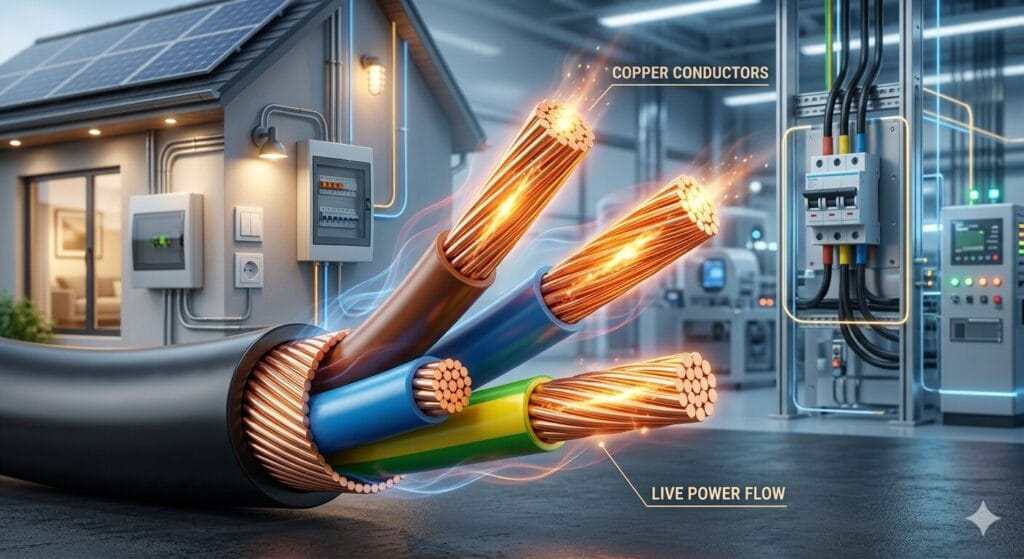
Advantages of Using Copper for Electrical Cables Electrical wiring is an essential part of today’s technology which is used in powering homes, appliances or even heavy duty machines. When it comes to selecting the medium for electrical wiring, copper has proved to be the most preferred option consistently. But why has this metal remained so much of industry dominance. This blog shall provide an answer to the question by positively answering copper wiring14 and above considering its uses and benefits thoroughly.
Conductivity : The Key to Efficient Electrical Flow
The Main Specification that Defines the Ripe Copper’s backbone advantages are its very conductive properties. That is the chief reason explaining why copper is a material of choice when it comes to electrical wiring. Most metals except silver rank less than 59.6 x 10⁶ S/m with the highest being given to copper. So, this high rating of conductance means that copper wires are able to carry any current with extremely low resistance; hence reducing energy wasted improving efficiency in power usage. In layman’s term this means that electricity bills will be lower while more optimal usage of electrical appliances will be experienced.
Ductility and Flexibility: Low-Level Difficulty in Handling
What makes copper exceptional, especially in making wires, is its ductility as well as its flexibility. Ductility simply explains a substance’s ability to be stretched into wires without causing fracturing of the structure. More without the risk encouraging deformation owing to copper’s higher ductility than others, wires can be shaped, bent and twisted to suit different environments of ‘wires’ installation ducts. In a room corner or within an elaborate Industrial installation such complicated designs in piping the copper can be installed without any risks of loosening.
Corrosion Resistance: Fully Practical
In addition to other attributes, corrossive resistance is also another benefit of copper. Unlike most metals that rust on exposure to moisture, copper actually creates a thin layer of copper oxide that protects it from rusting even more. This is an important trait as it allows the conductor materials to avoid deterioration in performance and structure due to corrosion or other hazardous elements. Copper wire lasts long, hence there is little need for the repeating cost of replacement, its economically viable over time. This longevity is especially helpful in situations which involves high ambient humidity or exposure to susceptible standing water.
Thermal Era : Heat Management Effect
Thermal conductivity is the property of the material which denotes how much heat can be conducted by the material. A good example of such material is copper which has a very high thermal conductivity appraisal helping it manage current flow temperatures optimally. Efficient heat dissipation is critical in reducing the chances of overheating and potential electrical failure. By using copper in your wiring, you guarantee that the surplus heat generated is removed in an optimal manner which makes electrical systems safer and more reliable.
Economical Point : Efficiency Sincerely Vs Cost Dependent Sincerely
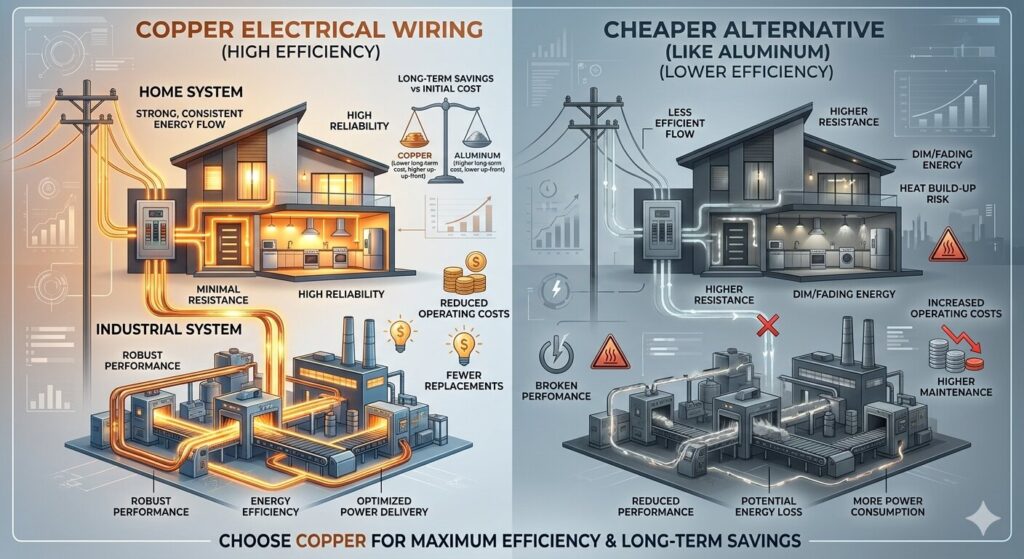
When compared to other materials like aluminum copper is more costly, however, throughout its use, it is economy prudence. Making use of copper’s beneficial properties such as high conductivity and durability often justifies its initial costs. At the same time, many copper wiring benefits in decreased energy loss and less replacement consumption, explain the very economics of copper wiring. In most cases, copper is worth the expenditure as most applications would require considerations to performance and lifespan.
Versatility : Use In A Variety Of Processes
Due to another related reason copper wiring dominates the electrical wiring industry. In terms of application, it cuts across domestic wiring to very high voltage transmission. Copper wiring can be encountered within the electrical systems of homes and businesses, through the aerospace and telecommunication industries, and other fields. Its usefulness as electrical wire is evident in its capacity to be modified to fit into different specifications and conditions.
Environmental Considerations : Waste Management And Conservation Of Resources
In the contemporary society, known for its eco-friendliness, the aspect of materials and manufacture being sustainable is of the utmost concern. This can be attributed to copper’s property of being recycled and used repeatedly without any quality deterioration. Recycling copper lessens the exhaustion of even new resources. By sourcing for copper wiring, you anchor the use of materials in a more sensible manner on the need to avert further damage to the natural habitat.
Why does copper seem to be the predominating component of almost all wires?
Wires are manufactured from copper because it has a high electrical conductivity. It allows quite an easy flow of electrical current with little or no resistance or loss of power. Among other properties, it is quite ductile, flexible, and can be easily shaped and fitted whereas it also has a very high resistance to corrosion which prolongs trustworthiness. Furthermore, it has good thermal conductivity which assists in overheating mitigation. Of course, the cost of such a metal is reasonably priced compared to other metals such as aluminum. Nevertheless, considering all the advantages of performance, longevity, and safety of copper wiring, it is no wonder why copper is selected for such duties.
Historical Context: Proven Track Record
Copper is generally a good conductor of electricity. A history in which performance was built No track record, no saleitiony whitethread.
This is not the first time that electrical wires made from copper technology wire, as this technology has been resources for many years. In the past history, electricity copper wires were used as it was the earliest electrical usages. Gradual history of events has rendered copper as an acceptable material within the industry. Because of this history use, the problem of copper will still be lack of use and desirability.
Risks and Safety: Taking Care of All Risks
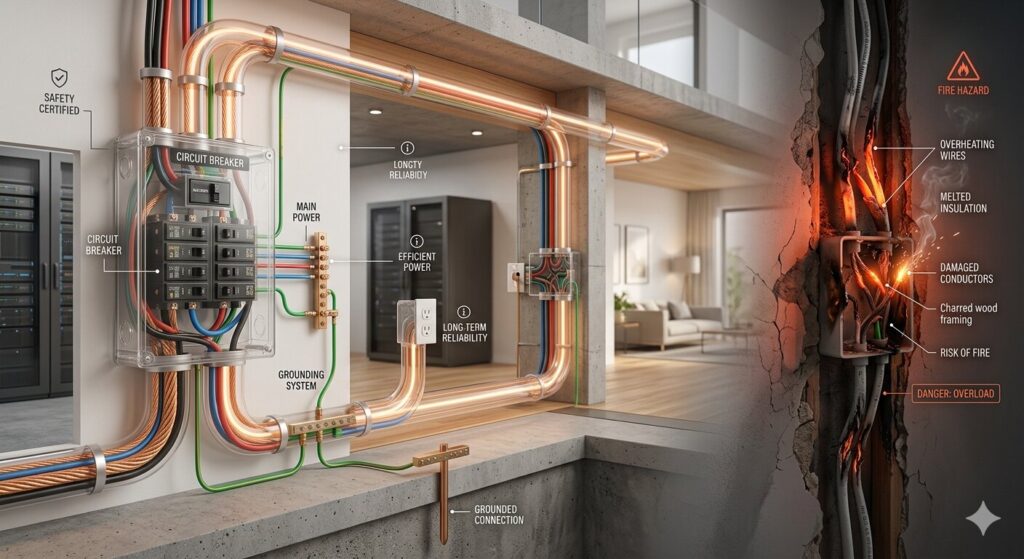
When it comes to electrical installations, Safety is a top priority. The good electrical and thermal conductivity of copper also make it safe. The properly installed wiring of copper reduces any overheating hazards and the possibility of snagging electrical fires. Also, copper wiring enhances electrical safety as it is reliable, thus alleviating the fears of users and the installers.
Conclusion:
Thus, copper wires have high electrical conductivity outshining all the other electrical materials because of its melting ability and other corrosion-resistant and thermal attributes. The seeds of proven cost-effectiveness, diversity, and eco-friendliness are the pillars that sustain the absolute imperialism of the commodity in the market. Safety has been one area where copper presents a strong advantage and the electrical industry continues to enjoy an efficient and effective system. As technologies expand and electricity requirements become higher, words at its use coursing will still remain as iron.
Therefore, knowing why copper is so much used for electrical wiring, we can understand its contribution for the world and its technologies. Whether you are a cottage owner or an installer or industrial professional or even a repairman, copper uses understanding would enable one to take rational choices cutting across electrical wiring issues while aid in the optimum safety and functioning of electrical systems.
Read our latest article about: Zener Diode : How to Better Understand the Applications and Uses
Frequently Asked Questions (FAQs) on Zener Diode : How to Better Understand the Applications and Uses
Q1. Why is copper widely used in electrical wiring?
Copper is almost universally used in electrical wiring because of its incredible electrical conductivity. Copper allows current to pass through with minimal resistance. This means wiring loses little energy to heating. Copper is one of the best available metals to use in electrical wiring because of its availability, conductivity, and cost. In addition, copper is very durable. It is also resistant to wear. This makes it ideal for use in industrial and residential wiring. Copper is very flexible, making it easy to form into wires. This also means wires are easy to install and maintain. All of these factors contribute to copper being the premier metal used for electrical wiring.
Q2. What makes copper a better conductor than most other metals?
Copper has many free electrons, making it a better conductor than most other metals. Free electrons are the electrons used to carry current. These electrons are able to pass through the copper’s lattice structure without obstruction, leading to minimal resistance. Because of its structure, metals like silver are able to be slightly better conductors. This is the only advantage silver has, leading to it being an impractical metal for electrical wiring. Copper is used extensively across electrical systems because of its high conductivity for a low cost.
Q3. How does copper compare to aluminum in electrical wiring?
Copper is preferred to aluminum in wiring because of its better conductivity and tensile strength. For example, aluminum wiring must have a larger diameter in order to support the same electrical current as its copper counterpart. This leads to a bulky installation. Furthermore, copper’s thermal expansion is accompanied by contraction less than aluminum. This quality promotes the loosening of thermal expansion wiring. Resulting in the increased risks of overheating and electrical fires. Although aluminum wiring is cheaper and lighter, the superior reliability, and safety copper wiring provides, makes copper the preferred metal.
Q4. Why is copper considered safe for electrical applications?
Safer metals must have materials with a higher melting point and better thermal conductivity than copper. Being thermally conductive copper can help with overheating, and the metal’s high melting point can lessen the overheating of wiring. The mechanism with which copper wire can corrode is also present a type of insulation. This helps to promote copper’s performance. Lastly, if copper maintains its integrity, electrical faults are less probable. Overall copper’s qualities promotes better safety.
Q5. How does copper’s flexibility benefit electrical wiring?
Copper’s ability to be drawn into wires without losing structural integrity permits copper wires to be shaped into complicated designs during installation. It can be bent into position, even around tight spaces, without concern about breaking. In addition, copper can be sufficiently repositioned without the threat of snapping. Applications for repositionable wiring benefit from the ductility of copper. The flexibility of copper wires translates to improved installation, faster construction, and fewer maintenance problems down the road.
Q6. What role does copper’s durability play in wiring systems?
Copper’s excellent durability translates to an ideal material for electrical systems that need to be reliable for a long time. Virtually unchanged for decades, copper can withstand bending, vibration, and the elements which can stress, degrade, or corrode other materials equally as quickly. For optimal performance, traditional materials that quickly degrade and lose conductivity do not compare to copper’s quality of sustaining conductivity. Copper’s durability, an invaluable quality, substantially decreases the need for frequent maintenance which adds further to it’s an already reasonable cost.
Q7. Why is copper resistant to corrosion?
Copper’s original oxides of the outer copper surface aren’t formed in a classical sense of oxidation. The original oxides that form the outer surface of copper are oxides that stop further copper oxidation or oxidation of the materials beneath the copper. Because of the oxide layer, moisture and other elements are not able to freely corrode the wires of copper. This is important in momentary corrodible environments because it prolongs and preservative electrical ability and efficiency even in demanding conditions.
Q8. How does copper improve energy efficiency?
Copper’s low electrical resistance means that energy is not lost to heat, so more energy is delivered to end devices. This means energy is not wasted. Good energy efficiency reduces electric bills and energy waste, which decreases the environmental impact. This energy efficiency is especially important in large scale power distribution where a large amount of energy could be used.
Q9. Why is copper preferred in high-load electrical systems?
Copper is one of the best option due to its electrical performance and durability. It not only retains its performance, but copper also does not overheat. It does not fail due to its high melting point. These properties make it the best choice for large scale power distribution and industrial engineering.
Q10. How does copper contribute to fire safety in buildings?
Copper not only enhances the safety of structures due to fire from electrical faults, but it also enhances safety due to its heat resistance. It has steady conductivity and does not allow current to flow freely for long. Because of loose connections, copper does have electrical faults. In maintaining performance and reducing chances of electrical faults, copper increases fire safety in structures.
Q11. Is copper environmentally friendly?
Yes, as copper is one of the most eco-friendly metals. Copper’s ability to be recycled many times without altering its key features makes this metal highly sustainable as it diminishes the need for more raw materials to be mined. Not only this, when copper is recycled, it is considerably more eco-friendly than having to mine new copper.
Q12. Why is copper cost-effective despite not being the cheapest metal?
Copper is more expensive than metals, like aluminum, because it is more durable, reliable, and has a long lifespan. These plus its high conductivity greatly reduce the need for constant upkeep. Copper’s qualities means that less materials are needed to accomplish the desired outcome. All of this makes copper the most economical choice when considering copper’s quality and the cost over a long period of time.
Q13. How does copper perform under extreme temperatures?
Copper is versatile and temperature extremes. These metals also deal expands and contracts without breaking, which helps the electrical connections. This means it is reliable in both hot and cold temperatures.
Q14. Why is copper used in modern technology and electronics?
Copper is used in technology other than pocket-microwaves and other household appliances, like phones, because it is reliable and it conducts energy very well. Copper is used everywhere in technology including, to connect wires in an entire house, to design circuit boards in computers, phones, and for to design wires in technology that produces renewable energy. Anything with technology that sends or produces energy will use copper to enhance the speed at which the energy is sends. As more technology is invented more and more copper is used to keep that innovation creating connection.
Q15. What are the overall advantages of using copper in electrical wiring?
Copper is everything you want in construction materials. It consists of the perfect balance of everything including safety, cost, durability, construction flexibility which all even out to copper being the optimal balance for construction materials, with the one caveat, it’s very expensive. Copper fuses energy quickly which with the perfect construction design will allow the greatest minimal construction to protect against any electrical hazards and will last for corroding years. It can withstand any enduring conditions for at least even interstellar space or any form of hell would be the only conditions that would shorten the corroding years. Copper is the best choice for construction materials in not just households, clinics, and even labs, but for construction materials in any building across the globe.
Q16. Why does copper have a long lifespan in electrical wiring?
Copper has a naturally long lifespan because it resists wear, corrosion, and mechanical damage better than many other materials. When used in wiring, it can function efficiently for decades without significant degradation. Its ability to maintain stable electrical conductivity over time ensures that the performance of the wiring system does not decline. Additionally, copper does not become brittle easily, so it can withstand repeated bending or environmental stress without cracking. This longevity reduces the need for replacements and contributes to the overall reliability of electrical systems.
Q17. How does copper minimize maintenance in electrical systems?
Copper wiring requires very little maintenance due to its strength, corrosion resistance, and stable conductivity. Unlike some other materials, it does not loosen easily at connections, which reduces the chances of faults or interruptions. Its durability also means that it can handle everyday wear and tear without frequent inspections or repairs. Because copper wiring systems remain reliable over long periods, electricians and homeowners spend less time and money on maintenance, making it a practical choice for long-term use.
Q18. Why is copper suitable for both indoor and outdoor wiring?
Copper is suitable for both indoor and outdoor use because it performs well under a wide range of environmental conditions. It resists moisture, temperature changes, and exposure to air, all of which can damage other materials. When properly insulated, copper wiring can function efficiently even in harsh outdoor environments, such as areas with high humidity or extreme weather. Its adaptability makes it ideal for various applications, from household wiring to outdoor power lines and industrial installations.
Q19. How does copper support modern renewable energy systems?
Copper plays a crucial role in renewable energy systems such as solar panels and wind turbines. These systems require efficient transmission of electricity from the source to storage or distribution points, and copper’s high conductivity ensures minimal energy loss. It is used in generators, transformers, inverters, and connecting cables within these systems. As the demand for clean energy grows, copper continues to be essential in ensuring that renewable energy systems operate efficiently and reliably.
Q20. Why is copper considered a standard material in electrical codes and regulations?
Copper is often included as a standard material in electrical codes and regulations because of its proven safety, reliability, and performance. Regulatory bodies prefer materials that have a long track record of safe use, and copper meets these requirements. Its consistent behavior under different conditions makes it easier to design systems that comply with safety standards. By using copper, engineers and electricians can ensure that installations meet established guidelines, reducing risks and improving overall system quality.