
Capacitors should be purchased in equal capacitance and this article giving an account of how to arrange them on the plate glass attempts to tackle that problem. Modern electronics heavily use capacitors for functions that include energy storage, signal filtering and stabilizing power supply. The arrangement of five equal capacitors with their connections is another example that interests this blogger. This blog contributes to understanding the concerns, applications, and calculations associated with such an arrangement, and thus bridges a gap between students and practitioners in the profession.
What are Capacitors?
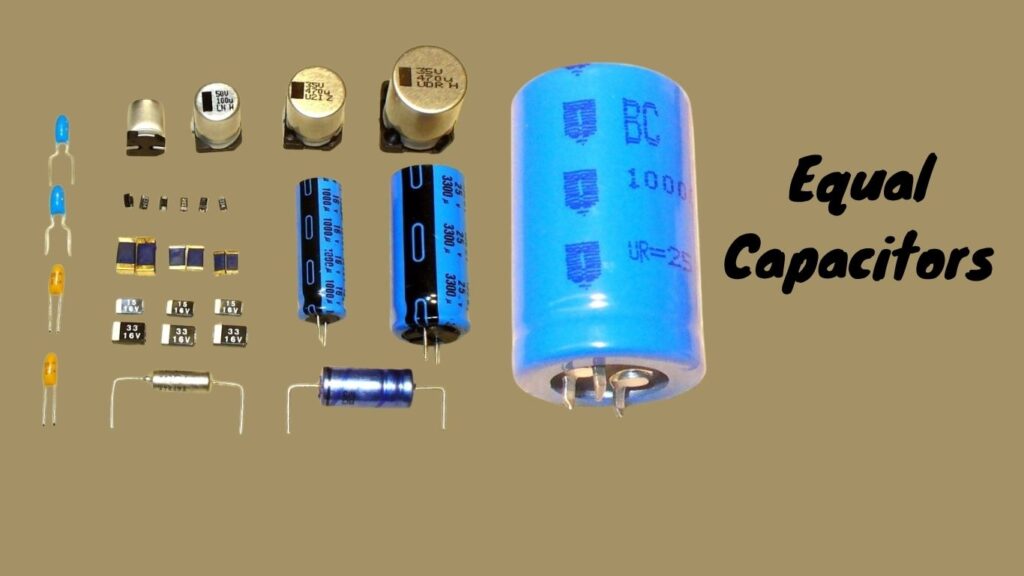
Save the capacitors for last, which is what we do in this section. Definition of equal Capacitors A capacitor is the electrical component with the capacity to store electrical energy in an electric field. Electric field energy storage devices have two metallic plates separated by an insulating material known as a dielectric. When a potential difference is maintained across the plates, an electric field is built up allowing the capacitor to absorb electrical energy. The ability of a capacitor to store electrical energy is defined in terms of the capacitance value which is expressed in farads (F).
The Role of Capacitors in Circuits
What Capacitors do in Circuits Most of the times, in most electronic circuits, capacitors are employed for the following purposes: Energy Storage: Capacitors charge and discharge very fast, which makes them useful for devices requiring fast pulses of power.
Energy Storage: Capacitors charge and discharge very fast, which makes them useful for devices requiring fast pulses of power.
Filtering: They are used to absorb the variation of power supplies, as well as eliminate some of the oddities in the signals’ processing.
Timing Applications: Cables and Capacitors combined with resistors form timers which are used in devices like oscillators and clocks.
Grasping these basic functions provides the foundation that allows information on capacitor arrangements to be finally availed.
Exploring Capacitor Arrangements
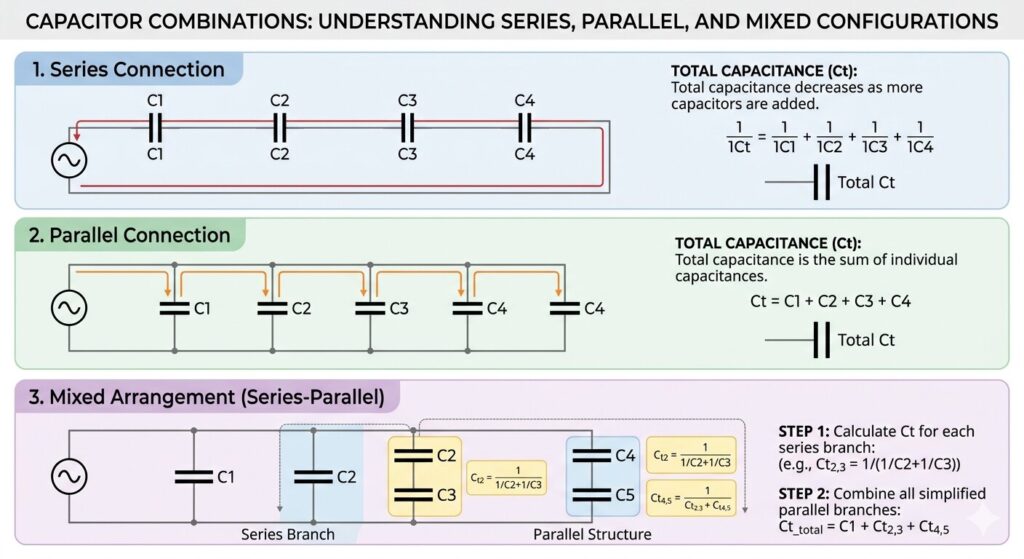
The arrangement of equal capacitors in a circuit leads to different total capacity based on whether the capacitors are connected in series or coefficient. The arrangement of capacitors affects the performance of the circuit thus understanding how to calculate total capacitance when bipolar capacitors are joined into a single arrangement is imperative.
Series Arrangement of Capacitors
In a series arrangement, the capacitors are connected end-to-end, and the total capacitance (C_total) can be calculated using the formula:

For five equal capacitors (C), the formula simplifies to:
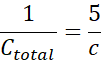
Thus, the total capacitance in a series arrangement of five equal capacitors is:

Parallel Arrangement of Capacitors
Conversely, in a parallel arrangement, the capacitors are connected such that they all share the same voltage across their terminals. The total capacitance for capacitors in parallel is the sum of their individual capacitances:

For five equal capacitors, the total capacitance becomes:

Implications of Series and Parallel Arrangements
The arrangement of capacitors has meaningful impacts on the operation of the electronic circuits.
Voltage Ratings: When capacitors are connected in series, the voltage rating across each capacitor is cumulative and this makes this arrangement ideal for high voltage applications. However, the overall capacitance increases less.
Capacitance Value: The total capacitance in a parallel arrangement is higher than that in other arrangements and so this arrangement is most suitable for applications that require more charge. However, the voltage rating is the same as that of one capacitor.
Applications of Capacitors in Various Fields
Understanding the bearing of usage of capacitors in different Fields Such components as a capacitor are used across many areas in the industry, domestic or even industrial systems. Here are some of the common uses:
1. Power supply systems: Capacitors form an effective part of power supply circuits, they smooth voltage variations and hence stable output is assured. They absorb excessive energy at high load and dispense it when the load is low.
2. Signal processing: To eliminate noise and other undesirable signal frequencies in audio and radio frequency systems, capacitors are employed to filter signals. They can be employed in equalizers, mixers and many other devices that require modification in signal form
3. Timing Circuits: As mentioned earlier, capacitors are critical in timing circuits. They determine the timing intervals in oscillators and timers, essential for clocks, alarms, and pulse-width modulation applications.
4. Motor Start Capacitors: In electric motors, start capacitors provide the necessary torque to start the motor. They are used in applications like air conditioners, refrigerators, and pumps.
5. Energy Storage Systems: Capacitors are increasingly being used in energy storage systems for renewable energy applications, such as solar and wind energy systems. They help balance energy supply and demand, enhancing the reliability of these systems.
Calculating the Total Capacitance of Five Equal Capacitors
To illustrate the calculations further, let’s assume each of the five equal capacitors has a capacitance value of 10 µF.
Series Calculation
Using the series formula:
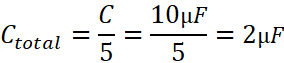
Parallel Calculation
Using the parallel formula:

These calculations provide clear insights into how the arrangement of capacitors can significantly alter the total capacitance in a circuit.
Conclusion
The knowledge of the disposition of five equal capacitors is important for individuals who are concerned with or practice electronics or electrical engineering. The configuration is of particular concern whether they are connected in series or parallel because of the effect on the overall capacitance, the voltage rating and the performance of the entire circuit. These devices find use in many applications ranging from consumer to industrial electronics. By doing so, one can be able to improve the layout of the electronic circuits.
Read our latest article about: The Hidden Costs of Low Power Factor: How It Increases Line Losses and Wastes Energy
Frequently Asked Questions (FAQs) on How to Make Best Arrangement of Five Equal Capacitors
Q1. Why do people say there is a best arrangement of five equal capacitors?
The best arrangement of five equal capacitors describes only one of the many configurations of capacitors that aims to accomplish a distinct goal. This goal can be maximizing total capacitance and determining the lowest possible capacitance or any intermediate value. With equal capacitors, the arrangement of the capacitors determines the outcome. Hence, the term, best is very subjective.
Q2. Which configuration gives the maximum capacitance?
Maximum capacitance is achieved when all five capacitors are connected in parallel. In this configuration, all the capacitors charge in unison, and their total impact is present. Hence, the capacitor bank can contain more charge at a given voltage. In a configuration where more charge storage is needed to be achieved, parallel configurations are used in power supply filtering or energy storage systems.
Q3. Which configuration gives the minimum capacitance?
Minimum capacitance is achieved in a configuration where all five capacitors are connected in series. In this configuration, the total ability to store charge diminishes because the capacitors share voltage among themselves. An increase in the net distance among the plates occurs, and an increase in capacitance is noted. Charge storage diminishes in this configuration. Series configurations are better when managing high voltages is needed rather than charge storage.
Q4. Can we get different capacitance values using the same five equal capacitors?
Yes. This is the exciting part. By adjusting the combination of series and parallel connections of the capacitors, one can achieve several capacitance values from the maximum capacitance to the minimum capacitance. For instance, connecting some capacitors in series to decrease their total capacitance and then connecting that set in parallel with others to further increase the total capacitance. This allows users to perform specific design tasks to build circuits that achieve a specific target capacitance design.
Q5. What is an example of a mixed arrangement of equal capacitors?
A frequent example of a mixed arrangement is subdividing the capacitors into groups. One could, for example, perform two pairs of capacitors in series and then join those pairs in parallel. The fifth capacitor can then be added in parallel to this entire combination. This arrangement is often seen where a moderate capacitance value is requested, and gives a result that is balanced, not too high and not too low.
Q6. Why does a series connection reduce capacitance?
In a series connection, the capacitors act as if they were a single capacitor having an increased plate separation as compared to the others. Capacitance is dependent on the distance of the plates and how easy the charge will be stored, thus the increased distance reduces the capacitance. Consequently, the circuit will store lesser charge compared to the parallel arrangement.
Q7. Why does a parallel connection increase capacitance?
In a parallel arrangement, it can be seen that that all capacitors are connected directly to the same battery. Thus, all capacitors can be fully utilized. This is exactly like increasing the area of the plates of a capacitor to store more charge. Hence, when connected in parallel, capacitors increase the total capacitance.
Q8. Which arrangement is most commonly used in practical circuits?
In most cases of practical applications, engineers never use a purely series or purely parallel arrangement. Rather they use a combination of both to suit the specifications. For instance, in the case of the power supply circuits, it is common to use parallel capacitors to achieve better storage capacity. On the other hand, in a high-voltage system, it is more appropriate to use series arrangements in order to distribute voltage appropriately.
Q9. How do you choose the best arrangement for a specific problem?
To choose the best arrangement, it is crucial that you understand your circuit thoroughly. For maximum storage of energy, a parallel arrangement is the best. For your circuit, if voltage is the most critical consideration, then a series arrangement will be best. For a combination of what is desired, in most cases a mixed arrangement will be the best. A step-by-step, grouping capacitors will achieve your desired expectation.
Q10. Is it possible to obtain the same capacitance value with different configurations?
Yes. Configurations can yield the same equivalent capacitance value due to balancing of series and parallel combinations. This encourages multiple solutions to a problem, which is why this topic is heavily featured in physics and engineering exercises.
Q11. Are five identical equal capacitors capable of producing different equivalent values in terms of capacitance?
In fact, five identical equal capacitors can produce many different equivalent capacitance values depending on how they are connected in series and in parallel. If connected in series, the capacitance values of the capacitors are added and, if connected in parallel, the capacitance values are multiplied by the number of capacitors. Many different simple and complex combinations are possible. It is for this reason that such problems are given in exams. These problems test the creative ability of students. Many different arrangements and combinations can be made.
Q12. Why is this topic such an important area of interest in Physics and Electronics?
This topic is important because it enhances understanding of how circuits are structured. In real engineering problems, especially in designing circuits, engineers are faced with the challenge of using dozens or hundreds of capacitors that they can choose. Understanding effective combinations of capacitors is crucial in designing circuits in power systems, communication systems, and numerous other applications.
Q13. Are there different systematic methods of arranging the equal capacitors?
Yes, there are systematic methods for arranging five capacitors. There is a systematic method of arranging the equal capacitors if there is a clear goal in terms of the level of capacitance (high, low or intermediate capacitance). If this goal is there, the next grouped capacitance combinations can be configured in pairs or other subgroups. This method is simple, logical and structured, and ensures that important configurations, arrangements or combinations are not missed.
Q14. What do students typically do incorrectly when solving these types of problems?
A misunderstanding of circuit problems leads students to think that they are only working with simple series or parallel combinations. Also, many students fail to think of the problem as consisting of many parts that must be simplified to achieve the correct solution. Some students underestimate the degree of simplification that can be accomplished beyond the layout of the problem.
Q15. Does it make any difference how the elements are positioned?
No, provided that the connections between the elements are the same. Generally, two circuits can appear to be completely different diagrams, but if the connections are the same, they will function the same. The way the circuits look in the diagram is not important.
Q16. Are we allowed to use all five capacitors, but in different groupings, at the same time?
Yes, and this is what leads to greater complexity in the arrangement. The five capacitors can be grouped in twos or threes, and those groups can be combined in different ways, leading to greater flexibility. This allows the designer to be exact about the total capacitance they want to achieve.
Q17. What is the relationship between voltage and arrangement?
In a parallel arrangement, the voltage is the same at all points. Conversely, in a series arrangement, the voltage is not the same but is divided. There are also mixed or hybrid arrangements, where some capacitors share the same voltage and some capacitors have divided voltages. This is an important behavior because it helps ensure that the voltage on the capacitors is less than the value on the capacitors.
Q18. What advantage do mixed combinations have that simple combinations do not?
Mixed combinations, compared to series combinations and parallel combinations, provide more flexibility in designing systems. This is because simple series and parallel combinations yield very extreme results; either very high or very low capacitance. In practice, circuits do not have extreme values, they have capacitance in between a certain value. Thus, using a combination of series and parallel arrangements, you can achieve a capacitance value that meets the requirement.
Q19. Is it possible to have different arrangements and configurations, yet have the same amount of stored energy?
Possibly, different configurations and arrangements can be designed to have the same energy stored. These arrangements use different components and are not the same at a glance, but at the most fundamental level, they exhibit the same behavior. This is an advantage in circuit design because it is not the only way to connect capacitors.
Q20. What is the value of practice in terms of capacitor arrangements?
Practice is essential, because, unlike other topics where you might be able to just memorize the formulas, this one is more logical. Practice is critically important, because, the more problems you solve, the more circuits you can break down into their basic compartments, and the simpler the circuits became to you, the more you were able to guide yourself to the arrangements that were going to be the least and most capacitive.
Q21. How does a series arrangement of five capacitors affect the total capacitance?
In a series arrangement, the five capacitors are connected one after another in a single path. This type of connection reduces the overall capacitance because the effective separation between the plates increases, which decreases the ability of the system to store charge. In this arrangement, each capacitor carries the same charge, but the total voltage applied across the circuit is divided among them. As a result, the series arrangement produces the minimum possible capacitance. It is mainly used in situations where higher voltage handling is required rather than high capacitance.