
Magneto Motive Force (MMF) is an elementary principle in electromagnetic theory and is utmost helpful in explaining the principles of operation of magnetic fields within electric devices. MMF is the source of magnetic flux in a wide range of devices, including transformers and electric motors. In this comprehensive article, the reader will learn what is meant by MMF, the principles of its operation, its mathematical expression, and areas of its use. At the conclusion of this guidance, you will know MMF better than most people do and why it is important in numerous electrical and electronic.

What is Magneto Motive Force (MMF)?
The force magneto motive (MMF) refers to the force produced within the magnetic circuit that is responsible for causing magnetic flux within the circuit. It is similar to electromotive force (EMF) regarding its equivalent function of directing the current through the electrical circuit. It is the component responsible for the magnetic field generation in devices like transformers, solenoids, inductors, and electric motors. It is more or less the ‘push’ or ‘pressure’ which makes magnetic flux move within the sheets.
The MMF is constructed upon the foundation of the concept of Ampere’s Law, which indicates the association of electric current with magnetism. Therefore, it is determined that the bigger the current or the number of laps of wire lying in a coil, the bigger is the MMF and the greater the magnetic force created. The unit of measurement of MMF is the Ampere-turns (At) being equal to this quantity and is the product of the current through the coil and the number of turns in the coil itself.
Formula Deriving Magneto Motive Force(MMF)
Mathematically, Magneto Motive Force (MMF) is expressed using the following formula:
Where:
- N is the number of turns in the coil or winding.
- I is the electric current flowing through the coil (in amperes).
The two values multiplied give Magneto Motive Force (MMF) in Ampere turns in (At). This formula makes it quite straight forward that for any enhancement in the current of the winding, the number of turns in the winding subject to the lower limit will stop yielding further enhancements in the MMF and generating the induced magnetic field.
Example of MMF Calculation:
MMF determination is the better appreciated with the help of an example. Let us assume that a coil has 200 turns and a current 5 amperes is flowing through that coil. The MMF can be calculated as follows:
To better understand how MMF is calculated, consider a simple example. Suppose you have a coil with 200 turns, and a current of 5 amperes flows through it. The MMF can be calculated as follows:
In this case, the MMF of the coil is 1000 At , which means the magnetic field is driven by a force equivalent to 1000 Ampere-turns.
How MMF Relates to Magnetic Flux
MMF is closely related to magnetic flux, the measure of the total magnetic field passing through a surface or a circuit. The relationship between Magneto Motive Force (MMF), magnetic flux and magnetic reluctance (R) is analogous to the relationship between voltage (V), current (I), and resistance (R) in an electrical circuit.
The following equation describes this relationship:
Where:
- Φ is the magnetic flux, measured in Weber’s (Wb).
- R is the magnetic reluctance, measured in Ampere-turns per Weber (At/Wb)
Magnetic reluctance is the opposition that a material presents to the flow of magnetic flux, similar to electrical resistance in a circuit. Therefore, a higher Magneto Motive Force (MMF) is needed to overcome the reluctance of a material in order to generate a desired magnetic flux.
Magnetic Reluctance and MMF
The parameters that determine the factors between magnetic reluctance include the permeability of the substance and the length of the level of the magnetic path. Magnetic flux can flow more easily through low-reluctance materials, such as iron, than through higher reluctance materials. Alternatively, air and plastic, which are non-magnetic materials, have very high reluctance such that it would be difficult for a magnetic flux to pass through them.
For example, in a magnetic circuit that uses a low-reluctance material such as iron, it would require only a smaller Magneto Motive Force MMF to achieve the desired magnetic flux generation. However, if the circuit consists of high-reluctance air gaps, a much larger MMF would be needed to barrage the same quantity of flux across the system.
MMF in Magnetic Circuits
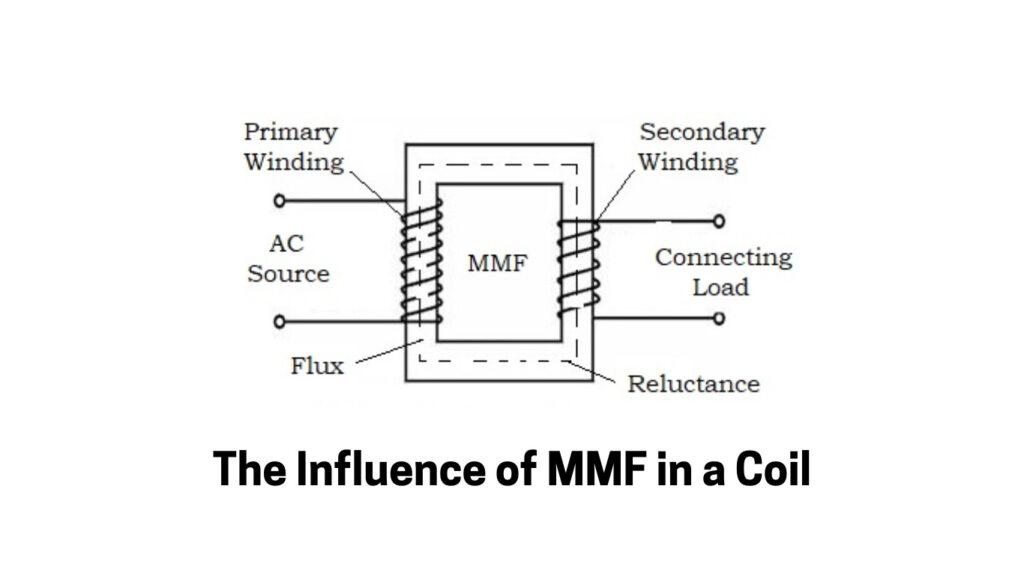
In the same way as electric circuits, magnetic circuits have elements which allows the passage of magnetic flux. These include core materials, air gaps and coil wires which provide the magnetic field. In magnetic circuits, Magneto Motive Force (MMF) is the energizing force meaning it is similar to voltage in electrical circuits.
A magnetic circuit can be described by the following relationship:
This equation shows that the magnetic flux is directly proportional to the MMF and inversely proportional to the reluctance of the circuit. In practical applications, engineers design magnetic circuits to optimize MMF and minimize reluctance, ensuring efficient magnetic flux generation.
Practical Example of Magneto Motive Force (MMF) in a Transformer
Another example in engineering that involves use of Magneto Motive Force (MMF) practically is transformer. In a transformer MMF is developing due to the current circulating in the primary coil. This MMF develops magnetic flux through the transformer core linking the primary and secondary coils.
For example, consider a transformer with 500 turns in the primary coil and a current of 2 amperes flowing through it. The MMF generated by the primary coil is:
This MMF initializes magnetic flux in the core of the transformer that further facilitates voltage induction in the secondary coil. The degree of effectiveness in this procedure is dependent on the reluctance of the core material used and the configuration of the magnetic circuit.
Factors Affecting Magneto Motive Force (MMF)
What are the factors that influence the effectiveness of the MMF in terms of producing magnetic flux? The following factors contribute to that.
- Number of Turns (N):
For a given current, the more the number of turns of wire on a coil, the more the MMF, the greater that will be the increase in the number of turns makes the magnetic field effective by increasing the driving forces into the magnetic field.
- Current (I):
With an increase in the current being passed through the coil, the Magneto Motive Force (MMF) also increases proportionally. Higher currents may also lead to higher power losses since the increase in the current will cause an increase of heat loss in the wire due to increased resistive forces.
- Core Material:
The core material used in any magnetic circuit decides its efficiency in terms of Reluctance hence the efficiency of the generated MMF. Magnetic materials like iron or ferrites dominate in the areas where intensive magnetic fields are required.
- Air Gaps:
Adding air gaps in a magnetic circuit increases the reluctance and requires added magnetic mmf to produce an equal amount of magnetic flux. In most cases, the air gaps present are managed well for the purpose of optimizing efficiency versus performance especially in the case of motors and transformers.
Applications of MMF
Magneto Motive Force finds use in a multitude of uses in different industries. Some of the most important applications of Magneto Motive Force (MMF) are:
- Transformers:
Within transformers, Magneto Motive Force MMF actively functions to produce a magnetic flux within the core which ensures energy transfer from the primary to the secondary coils. This is vital for the conversion of voltage in power systems and networks.
- Electric Motors:
Electric motors require MMF in order to create induced fields which interact with the rotor to provide motion. In both AC and DC motors, MMF resulting from Stator winding is essential of motor operation.
- Inductors
Inductors are electrical components that store energy in the magnetic field developed within them while electric current flows through. The inductive reactance or inductance in general is dependent on the amount of magneto-motive force or the MMF which is exerted in the form of the turns of coil of wire.
- Solenoids
Solenoids are a type of electromagnetic device that find application in switches, cylinders and other devices called actuators or mechanisms called relays. The MMF in the coil of the solenoid creates a way to move a magnetic plunger or armature to do work.
- Magnetic Sensors
The very important use of Magneto Motive Force (MMF) is magnetic sensors where MMF is used to induce the Magnetic Field Induction Rather Hall Effect Sensors are one of such sensors amongst others. Typical applications are found within automotive and industrial as well as consumer electronic industries.
MMF vs EMF: Key Differences

MMF and EMF are both forces that cause a flow-MMF for magnetic flux and EMF for electric current. However, both are usable in their different domains. The main areas of distinction between MMF and EMF are as below;
• Domain: MMF causes movement of magnetic flux while EMF, electric current.
• Units: unit of MMF is Ampere turns (At); unit of EMF is volts (V).
• Applicability: MMF concept is applicable in magnetic circuits, while EMF concept is relevant in electrical circuits.
Nonetheless, MMF and EMF should be considered as closely related phenomena as opposites in this case. For example, the MMF created in one coil by a current heating it produces a magnetic field, and this magnetic field can cause an EMF in some other coil through electromagnetic induction.
CONCLUSION
Magneto Motive Force (MMF) is the first and foremost concept that needs to be understood in electromagnetism since this phenomenon involves the creation as well as the control of magnetic fields around electrical devices. It is the working force that causes the passage of magnetic flux in the magnetic circuit and it is particularly important in the functioning of transformers, motors, inductors and electromagnetic systems.
For engineers and technicians dealing with electrical and electronic installations, an understanding of MMF, its formulation and its comparison with parameters such as magnetic flux and circuit reluctance is necessary. Focused use of MMF and reduction of magnetic flux reluctance allows creating more effective magnetic field systems which may reside in devices for energy transfer and energy conversion.
Be it a transformer, an electric motor, or a solenoid, understanding of MMF will benefit you in handling most situations.
Read our latest Blog about The Ultimate Guide to Types of Electric Motors
FAQs People Also Ask About Magneto Motive Force (MMF)
Q1.What is Magneto Motive Force (MMF)?
Magneto Motive Force (MMF) may be defined as the cause for the formation of the magnetic field in a magnetic circuit. Unlike electromotive force (EMF), which is found in electrical circuits, magnetic force pertains to magnetism. Hence, MMF is necessary for the magnetization of a body which results to the flow of magnetic flux in a circuit.
Q2.How is MMF different from electromotive force (EMF)?
Current and MMF both classify as forces, but different forces, MMF is the set that may be an off against its corresponding EMF. The MMF creates movement of the magnetic field in the magnetic circuit, while the EMF enables the flow of current through the wire. While EMF is represented in volts, the equivalent or corresponding representation of MMF is in ampere-turns.
Q3.What is the mathematical formula for calculating MMF?
The formula for MMF is MMF=N×I, where N is the number of turns in the coil, and I is the current flowing through it. This equation highlights that MMF depends on the total current flowing through the coil’s windings.
Q4.What are the units used to measure MMF?
The standard unit for MMF is the ampere-turn (A·t). This unit emphasizes that MMF is the product of current (amperes) and the number of turns in a coil.
Q5.How does MMF relate to magnetic field strength (H)?
MMF directly influences magnetic field strength (HHH), which is defined as,
A higher MMF typically results in a stronger magnetic field, depending on the material’s properties and path length
Q6.What are the main applications of MMF in electrical engineering?
MMF is essential in all gadgets that rely on magnetic fields like transformers, electric motors, generators and solenoids. It supports the conversion of electrical energy into mechanical movement or magnetic energy for power transmission and electromechanical equipment.
Q7.How is Magneto Motive Force used in the design of transformers and electric motors?
In transformers, MMF produces the necessary magnetic flux to facilitate energy transfer from primary to secondary windings. In motor systems, it is also used to create the required torque since MMF generates a magnetic field that interacts with rotor currents.
Q8.What role does Magneto Motive Force play in magnetic circuits?
Magnetic circuits can be compared to voltage containing circuits which are both mechanical and electrical as they are both driven by pressure. This allows MMF to be regarded as the pressure or force that counters any resistance in its path through the use of a magnetic circuit.
Q9.Why is Magneto Motive Force important for achieving electromagnetic efficiency?
Energy losses are minimized by optimal MMF generation since there is reduced saturation, hysteresis, or heating which is very important for components such as transformers and electric motors. This is key to the devices working at their best.
Q10.How does Magneto Motive Force impact the performance of solenoids?
The range and strength of solenoid generated fields are all dependent on the MMF, Thus high MMF values guarantee a more reliable actuation performance to the devices, such as stronger pulling force in relays and valves.
Optimizing and Improving Efficiency of Electromagnetic Machines
Q11.How does Magneto Motive Force contribute to electromagnetic efficiency in devices?
Yes, it limits the necessity for power losses, promotes the conversion or transfer of energy while at the same time utilizing strong and focused magnetic fields. Performance of electrical machines is therefore improved as well.
Q12.What factors affect the efficiency of Magneto Motive Force in practical systems?
The quality of the core material, number of coil turns, current and the geometry and length of the magnetic path. Core materials with weak properties or high reluctance limit the utilization of MMF dramatically.
Q13.What is the relationship between Magneto Motive Force and core losses in transformers?
Core materials continuously leads to hysteresis and eddy currents forming coil losses in the transformer and this can be avoided by ensuring that MMF is always optimized. This may be achieved through the use of quality core materials.
Q14.How can Magneto Motive Force be optimized to reduce energy loss?
You can change the number of turns on coils to design them appropriately, use materials of as low reluctance as possible and reduce flux leakage. Insulation and proper cooling also improve MMF’s efficiency.
Q15.What materials are best for maximizing Magneto Motive Force efficiency?
For improved MMF efficiency, materials with good magnetic properties such as silicon steel, ferrites, etc., are the best. These materials come in handy, as they permit the free flow of the magnetic flux, and thus the amount of MMF required to generate this flux is less.
Q16.What is the difference between MMF and magnetic flux?
The concept of MMF is in many ways similar to that of magnetic fields, but they are not the same, as MMF is a factor that causes magnetic vortices, while the latter denotes a concentration of magnetic energy circulating within a conductor.
Q17.How does coil winding affect MMF?
The number and arrangement of coil windings are the geometrical parameters that directly affect the MMF. The problem may arise due to increased heat, and energy losses when increasing the number of turns or the current to reinforce MMF.
Q18.What happens if there is an imbalance in MMF in a system?
When there is MMF imbalance, the magnetic field distribution across the system is not uniform, hence energy efficiency is low, there is noise pollution or it can even result in transformers and motors failing. This indicates that the MMF has to be designed in a way it is balanced within the system.
Q19.How do hysteresis and eddy currents impact MMF efficiency?
Hysteresis and eddy currents cause energy losses in magnetic cores. Losses like these can be alleviated through the application of more MMF, however this lowers the efficiency. Using laminated cores and high-quality materials minimizes these effects.
Q20.What are common issues in MMF-related systems and how are they resolved?
Core saturation, overheating and flux leakage are some of the core concerns. Appropriate core geometry, heating mechanic, and selection of insulating materials, as well as other design elements are provided to alleviate this concern.
Q21.How does MMF influence the development of modern electric vehicles?
The electric motors in the vehicles depend on the mmf to bring about the required torque for the vehicle to move. In vehicles, optimization of MMF results in reduction of energy losses, thereby increasing the range and efficiency of operation of electric vehicles.
Q22.What role does MMF play in renewable energy systems, such as wind turbines?
MMF drives the wind turbine generators which produce electricity from mechanical work. Minimum MMF loss ensures best possible end result in energy conversion and thus enhances the effectiveness of renewable systems.
Q23.How is MMF applied in the design of efficient power electronics?
MMF is important in inductors and transformers that are utilized in power electronics. It facilitates effective energy transfer as well as filtering thus lead to a decrease in power losses while enhancing the performance of the devices.
Q24.Can advancements in materials science improve MMF performance?
Yes, new magnetic materials exhibiting high permeability and low losses can substantially improve MMF performance. This decreases energy consumption and increases device efficacy.
Q25.What innovations are being made to enhance MMF-related efficiency in modern devices?
Superconducting materials, advanced cooling technologies, and AI-enhanced design processes are evolving MMF applications. These solutions are facilitating the development of small, high-performance devices.