

The Purpose of Power System Analysis
Of all the activities in the field of electrical engineering, the analysis of power systems is perhaps one of the most significant defining stability, efficiency and reliability of the electrical power systems. As the appetite for electricity continues to increase due to numerous factors, it becomes evident that one has to garner the aspects of power system analysis deeply in order to become useful to the society and energy sector specialists. This post is aimed at explaining, in a step by step manner, the core principles, methods and advantages of power system analysis and optimizing the power systems to effectively and efficiently deliver maximum expected performance.
Power system analysis definition
Power system analysis is the quantitative analysis of electrical power systems, this process includes their recommendations about changes necessary for their effective operation. It includes a series of different actions including but not limited to modeling, simulating, and analyzing electrical grids. Consequently, the desired results of power system analysis can be ensured when these systems can comfortably and reliably satisfy the load demands while functioning optimally with minimum utilization of the resources. Some key details of power systems include generators, transformers, transmission lines, and load centers. Their analysis helps them in determining possible limitations of the system so that remedies can be developed to improve its performance and to operate at higher levels of efficiency.
Approaches To Power System Analysis
In power system analysis, various techniques are put into consideration in the evaluation of different aspects of power systems. These techniques include:
- Power System Load Flow: generally referred to as power flow analysis, this technique is used to determine the flow of electrical energy within the system. It aids in the evaluation of the voltage, the loads and the potential losses in the system to be able to remain within acceptable limits.
- Short Circuit Studies: This technique establishes the performance level of the system under abnormal conditions such as a short circuit. System variables affected by fault currents and damaged elements are included in the analysis, creating opportunities for applying design techniques for user safety and equipment integrity, even.
- System Dynamics & Stability Studies: Stability analysis addresses the issue of coherency in a system during disturbances; whether a system will remain in synchronism after such extensive activity. It assists in analyzing how a system responds after a sudden change, be it load increase or generation, and if it is able to go back to a stable regime.
- Transient Response of System: This method is reactive and it aims at determining the effect of the external action on the system rather than the effect of the system on the external action as in stead-state analysis. This technique analyzes how the system operates for short periods of time and indicates problems that may occur in the system that may affect its operation.
Benefits of Power System Analysis
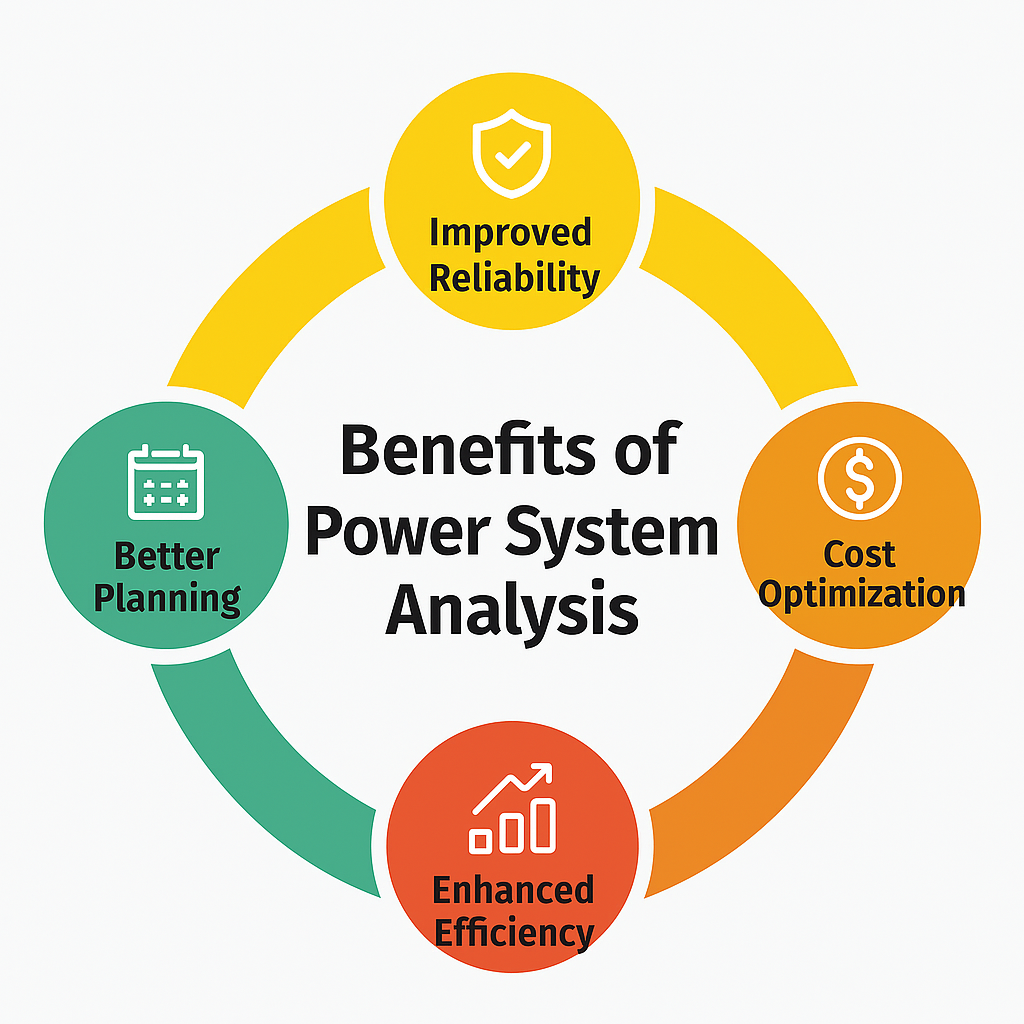
Numerous benefits emanate from effective power system analysis such as:
- Improved Reliability: It has been observed that for any problem brought forth by power system analysis, there exists at least a possible solution to counter this, thus improving the reliability of electrical power systems. This ensures that stress and fault conditions and load changes are handled by the system successfully.
- Enhanced Efficiency: Operations of generators, transformers, and transmission lines outperform their rated units through the application of power system analysis. To achieve this goal, power losses will have to be reduced.
- Cost Savings: Costs are substantial from power efficiency since boosting system performance and cutting losses means money. It assists in reduction of operational and maintenance expenditures while maximizing the average revenue per investment.
- Safety and Compliance: The system functionality is essential particularly during power system analysis so that safety margins of a system are not exceeded and industry norms and regulations are adhered to. The system guarantees creation and application of safety measures and procedures to avert incidents, injuries and damage to equipment.
Challenges in Power System Analysis

In spite of the fact that power system analysis is of utmost importance, this is also coupled with certain challenges. Some of these challenges include:
- Complexity: The current-day power systems are not only large but also have many elements and parameters. Analyzing such systems require high levels of modeling and software simulation so as to enable accurate forecasting about the performance of the system.
- Data Accuracy: Accurate data is the backbone of any power system analysis. Whereby wrong or missing information will result in wrong assessments and ineffective solutions.
- Integration of Renewable Energy: The integration of renewable energy sources, like wind and solar energy, makes power system analysis more complex. The intermittency of these sources needs to be well catered for by the engineers to ensure stability and reliability of the entire system.
Future Trends in Power System Analysis

The wake of technological advancements and new practices is affecting the landscape of power system analysis. Some future trends may include:
- Smart Grids: Smart grids involve the control and monitoring of telecommunications networks through the incorporation of networks of advanced sensors, communication technologies and automation in the management of power systems. Smart grids with the installation of parallel data analytics capabilities will have faster review cycles and enhanced optimization of global process flows.
- Big Data and Analytics: There are changes and still are changes towards using big data and change of existing analytic structures making power system analysis a more accurate science. Business decisions have invariably improved along with the management of systems as a result of data oriented approaches.
- Artificial Intelligence (AI): There is an increasing utilization of AI and machine learning techniques in power systems analysis to forecast behavior, performance optimization, and even fault diagnosis. Such technologies are known to make the analysis process more productive. 4. Integration of Energy Storage: Energy storage systems like batteries are key to matching power supply with demand in power systems. Examining the embedding of such systems better controls variability and enhances stability within the system.
Conclusion
Power system analysis has become an essential facet of electrical engineering practice in today’s world for it guarantees a proven and optimal use of electrical power systems. It is without a doubt that such a comprehensive study of power systems analysis will guarantee vast improvements to the system’s efficiency, reliability as well as reduce costs. This will incorporate the coming technologies that are presently unavailable in the current practice. Wherever there are number of electric systems there is great innovation going on in the settlement of electric power systems and new systems of analysis, power system analysis in particular will benefit from it.
Read our latest article about Transformer Protection Basics
Frequently Asked Questions (FAQs) on Power System Analysis.
Q1.Can AI and machine learning enhance Power System Analysis?
Yes, Artificial Intelligence (AI) and Machine Learning (ML) are revolutionizing the field of Power System Analysis by enabling smarter, faster, and more accurate decision-making across all layers of power system operations—from generation and transmission to distribution and consumption.
Traditionally, power system studies like load flow, fault analysis, and stability assessments rely on deterministic models, historical data, and complex equations. While effective, these conventional methods often fall short when dealing with the real-time dynamics, uncertainties, and increasing complexity of modern power grids, especially with the integration of renewable energy sources, electric vehicles, smart loads, and distributed energy resources (DERs).
Q2.Why is Power System Analysis important in electrical engineering?
Power System Analysis is one of the most basic means of maintaining the reliability, stability, and optimum function of electrical networks. With this analysis, engineers are able to predict the executability of different actions on the systems, enabling design solutions in case of faults and failures. Furthermore, this analysis strengthens the reliability of integrating renewable energy sources, provides load forecasting, ensures regulatory compliance, and therefore, contributes greatly to modern engineering.
Q3.What are the main types of Power System Analysis?
The most important types of Power System Analysis are:
- Load Flow Analysis: Identifies voltage levels and determines the amount of power generated or expended by a component in the system as well as losses.
- Short Circuit Analysis: Looks for fault currents and purposes appropriate protective devices for use.
- Stability Analysis: Measures the ability of the system to return to the normal operating state after disturbances.
- Harmonic Analysis: Checks non-linear loads that cause distortion to the waveform known as harmonic.
- Contingency Analysis: Assesses the performance of the system for possible outage scenarios.
Q4.What is Load Flow Analysis and why is it used?
Load Flow, or Power Flow, Analysis is used to find the values of bus voltages along with the power being transmitted over the overhead power lines in a defined power system. This analysis is critical when considering system upgrades, optimizing operations during different load scenarios, and monitoring the system’s volts and amps to verify they are within acceptable levels. Newton-Raphson and Gauss-Seidel methods are used to perform this type of analysis.
Q5.How is Short Circuit Analysis performed in power systems?
Short Circuit Analysis entails testing for fault conditions like line to ground or three phase faults and determining how high the fault currents can get. In defining the system, the engineers model all its constituent’s components, add in the fault scenarios and compute the fault currents using symmetrical components or impedance models. This analysis ensures that the ratings and coordination of protective devices such as circuit breakers and relays will result in swift fault isolation to protect equipment from damage and maintain system stability.
Q6.What software is commonly used for Power System Analysis?
The per-unit system is a method of use where electrical quantities are expressed in fractions in relation to their selected base voltage, current, power, and impedance values. Such an approach normalizes computations and makes them easier in the different portions of an electrical power system, more so when transforming into higher voltages and dealing with transformers. Making values to be considered as parts of their base values streamline the computations that are complex, thus improving the overall consistency of the results and the overall analysis.
Q7.How does Power System Stability Analysis work?
The Power System Stability Analysis considers whether or not a system can revert back to steady-state conditions after undergoing a disturbance such as a fault or a sudden change in load. It includes:
- Rotor Angle Stability: Deals with the requirement of keeping synchronism among generators.
- Voltage Stability: Keeps limits on how low or high voltage is.
- Frequency Stability: Looks after the system frequency with help of balance mechanisms.
- Disturbance simulations and time-domain studies are performed by engineers to evaluate these parameters which form the basis for assessing the system’s reliability against different disturbances.
Q8.What are the key parameters involved in Power System Analysis?
A number of industrial power system analysis automation tools are available for sophisticated power system studies:
- ETAP: Popular in industrial and utility systems.
- MATLAB/Simulink: Well known due to its versatility in academia and research.
- PSS®E: Frequently used for large scale planning for transmission systems.
- PSCAD: Most appropriate for the electromagnetic transient analysis of power systems.
- CYME: Applied in studies of the distribution system.
Q9.What is per-unit (pu) system in Power System Analysis?
Key parameters form the general outline of a Power System Analysis:
- Voltage and Current: Basic parameters for determining overall system health.
- Real and Reactive Power: Vital for the balance and power factor.
- Impedance and Admittance: Influence the system’s power flow and loss.
- Frequency: Balancing factor between generation and load.
- Power Factor: Indicates how efficiently a system uses energy.
Monitoring and analyzing these parameters aid system performance optimization, ensuring reliability for engineers.
Q10.Can Power System Analysis help integrate renewable energy sources?
Certainly. Power System Analysis is fundamental for gauging the effect of renewable sources of energy like wind and solar power on the grid. It assists in evaluating load matching, changes in voltage, fault contributions, and intermittency management. Dynamic simulation and probabilistic analysis are some of the tools used to model variability to improve grid reliability and ensure renewables can be easily integrated into the power system.
Q11.What are common challenges in Power System Analysis?
Typical issues include:
- Data Quality and Availability: Adequate and accurate modeling needs granular and up-to-date data.
- Engineering Pro Guides
- Model Complexity: Newer systems are characterized by multiple generation points and smart devices.
- Intermittent Generation: Greater uncertainty and variability occurs with renewable generation sources.
- Cybersecurity: Digital infrastructures are at risk of being attacked.
Q12.How often should power system studies be conducted?
Power System Protection is one of the most vital parts in Power System Analysis. It functions to prevent damage to the system and ensure the safety of personally while isolating faults or some abnormal conditions in the electrical network. A part from that, it maintains system equilibrium. Failsafe systems comprise relays, circuit breakers, and fuses. Together with communication schemes, they form the protection system that identifies, locates, and takes action against short circuits, overloads, and breakdowns.
Power System Analysis assists in providing protection by:
- Calculating the boundaries of fault levels for different nodes in the system.
- Facilitating in control over relay coordination and other protective devices to make sure they function in the required order.
- Guaranteeing a selectivity which permits the disconnection of only the faulted area while allowing the rest of the system to retain operations.
- Aiding in arc flash study evaluation which is important in worksite safety.
In the absence of protection design based on detailed analysis, even minor inconsistencies could lead to widespread outages. Protection engineering increases recovery and dependability specially in high voltage interconnected systems.
Q13.What is the difference between steady-state and dynamic analysis?
The quality of power describes the cleanliness and stability of the current and voltage in the power system. The sags and swells of voltage, harmonics, flickers, and transients can potentially damage sensitive equipment, lower energy efficiency, and lead to system failures. These problems can be solved using Power System Analysis and:
- Harmonic Analysis: Identifies distortion of waveforms due to nonlinear loads like inverters, variable speed drives, and computers.
- Voltage Profile Studies: Check the network for deviations from nominal voltage parameters.
- Flicker Analysis: Monitors voltage fluctuations that may impact lighting and consumer electronics.
- Transient Analysis: Looks at high-frequency disturbances coming from switching and lightning.
Industrial operations, data centers, renewable energy systems, and other entities greatly benefit from high power quality. With tailored preventive measures, utilities can eliminate downtime and ensure uninterrupted operations for their consumers.
Q14.How is Power System Analysis used in real-world applications?
Within Power System Analysis, Economic Dispatch is a process that entails allocating power generation across available units in a manner that meets the load demand in the most cost-effective way while observing system constraints and reliability standards. For utilities and grid operators, this is a key component to operational efficiency and economic performance.
Some of the more important things to note:
- Load Flow Analysis’s input to find out how power is flowing through the network.
- Generation cost functions, also termed as cost allocation functions, articulate the expenses associated with producing a certain unit of electricity.
- As with any system, there are boundaries determined by physical factors such as generator limits, ramp rates, and line capacities which interrelate with each other in a complex manner.
- Optimizations using algorithms or AI based approaches are done in real-time in modern smart grids.
With the inclusion of renewable resources, the complexity of Economic Dispatch multiplies given the uncertainty of their supply. Latest approaches to dispatch have included demand response, storage forecasting, and even predictive modeling to offer complete control over system complexities while sustaining generation cost reduction and system stability.