
There is no doubt that electricity is an indispensable part of everyday life, however, it also brings about some problems such as power surges, fluctuating voltages, and wastage of energy. Homeowners’ concern is how to protect household appliances and make more efficient use of energy. Whole-house capacitors and whole-house surge protectors are two essential devices that can be useful in protecting your electrical system.
In this article, we will discuss the meaning of whole house capacitors and whole house surge protectors as well as their importance in the house. We will also cover their benefits, reasons for installation, and the applicability of each. By the end of this post, you will be well-versed in the importance of those devices for the home electrical system.
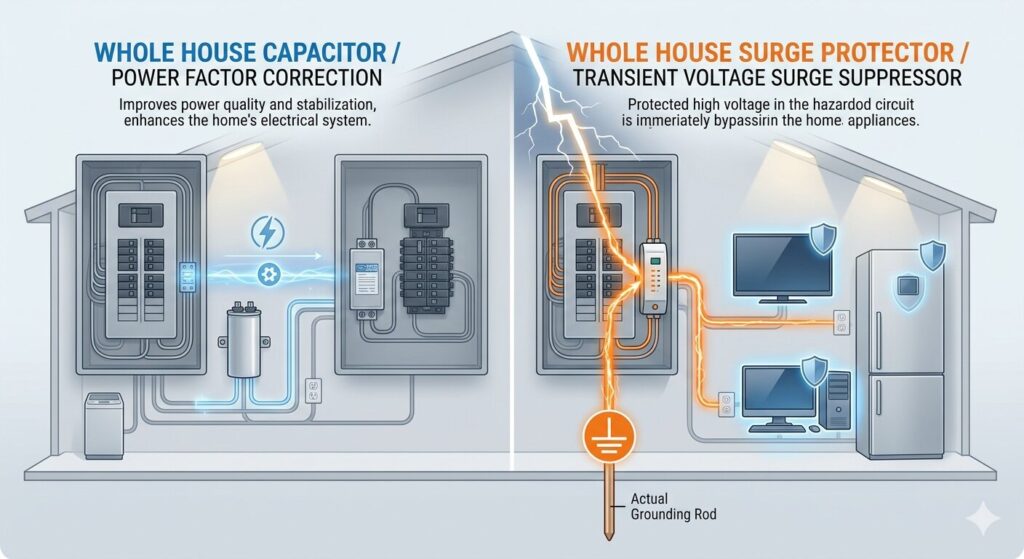
What is a Whole House Capacitor?
A whole house active filter is a power saving gadget which is aimed at correcting and enhancing power usage in homes. In electrical engineering, a Capacitor is electrical energy storage device (in this case) that is used to stabilize voltage sag or swell and optimize electrical usage in the home.
Large appliances such as air-conditioners, refrigerators, and washing machines are known to cause brief bursts or overvoltage in usage electricity whenever they are switched on. If not dealt with, however, these spikes may start over time to put a strain on your electrical system and shorten the life span of your electrical appliances. A whole house capacitor captures and stores the extra current and releases it safely to counter the voltage spikes thus preventing noticeable over current.
How Does a Whole House Capacitor Work?
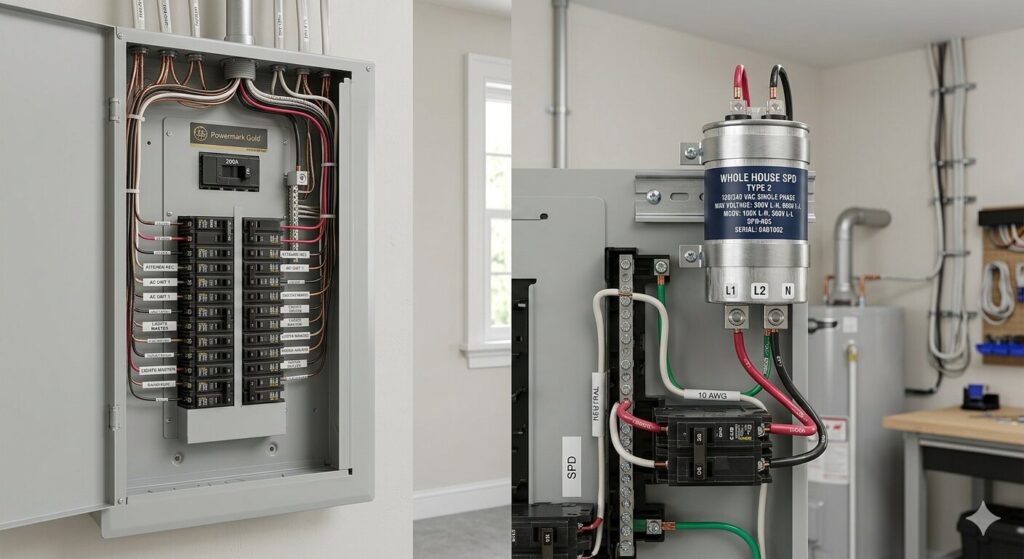
Basically, the capacitor takes in voltage when it is higher than the required and gives it out when there is a drop in value. This is done using a capacitor that connects your house’s system with the electrical grid.
This is how it works with the basic steps:
- Voltage regulation: This will be in form of the capacitors responding to the voltage that is applied to the home and peak levels.
- Energy storage: Electric current is in a circuit with active electrical devices only without any voltage values that are called the working voltage. A lot of current flows but no device works.
- Energy release: During some of these points when none of these normally active devices are present and active, power will be needed for two or more devices. This is where the capacitor will spring into action and provide what is needed to replace what is not available.
This positively reduces your electrical system strain, and increases the efficiency of your home appliances, thereby enhancing the chances of reduced energy consumption.
The Benefits of Installing a Whole House Capacitor
There are a number of benefits that come with implementing a whole house capacitor:
- Energy Efficiency: Energy wastage is eliminated, leading to lower electricity costs.
- Extended Appliance Lifespan: Wear and tear of appliances is reduced since a capacitor helps maintain standard voltage levels.
- Better Power Quality: Energy is conserved by preventing voltage dips and peaks through the use of capacitors resulting in better energy quality.
- Reduced Electrical Noise: Rapid changes in voltage levels may create “electrical noise” that interferes with the functioning of many electrical devices. Capacitors can reduce this noise.
What is a Surge Protector?
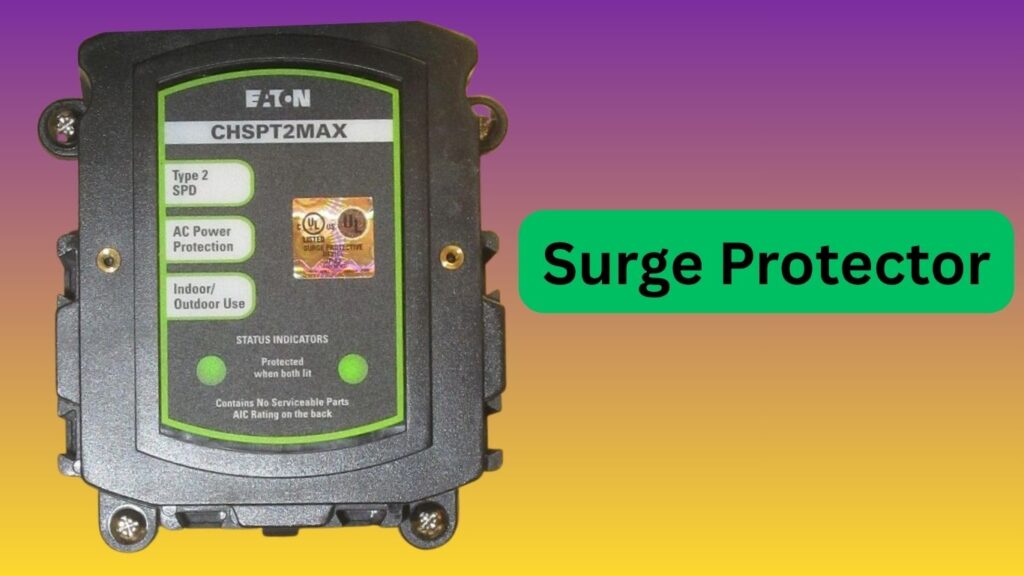
A surge protector is a type of electrical device intended to protect electrical devices and systems against excessive power surges. Power surges, or spikes in voltage, can arise from frenetic activities such as lightning, loss of electric ty and switching on heavy machines.
The destructive power surges tend to drive through an unwanted harnessing of volts within the wires composing the electrical system in a certain house. Such electrical pulses may damage all house appliances, electronics, and wires all around the house. It redirects excess voltage from the electrical system of the house to the surge protector ensuring no electricity reaches the devices.
What Does Whole House Surge Protection Provide?
The whole house surge protection device is fitted at the base of the wall where the electric systems come and is referred to as the main electric panel which controls the voltage that enters the house. Whenever surges happen constantly, the surge embarrassing device immediately connects the set above the neutral wire to the ground so as to prevent the electrical current from passing through the circuits in the house.
The following is an overview of how the procedure works:
- Monitoring Voltage: The surge protector remains ready and engaged to monitor the incoming rods/stabs each time.
- Diverting high Voltage: A surge obviously comes about and in this section, the device maker will be quick, and in so doing it will relieve the electrical maze and relay the leak to the ground.
- Coverage on All Electrical Points: In this case, since the installation is done at the stage where the electric meters are fixed and connected there, the whole house surge protector prevents any chances of powering any of the sockets and appliances within the house.
Advantages of Whole House Surge Protection
Installing a whole house surge protection is a good investment when considering the safety of the home environment:
- Risk Elimination: Since internal surge protectors are not able to provide the same long lasting protection as the external ones, a whole house system covers many devices from large appliances to hundreds of mobile phones.
- Dishwasher/Cables Protection: High voltage blow out currents which accompanies electrical surges/endangering leading to gross electrical surges and impacts on microwave ovens, refrigerators, HVAC, and washing machines etc., are protected by jumbo clamps.
- Protection Against Electrical Shock: A whole house surge protective device protects the household and its electrical appliances from indirect lightning attacks however does not guarantee total shield against a direct lightning assault.
- Improved Safety: Wiring can be damaged by the cause power surges which leads to electrical fires. A surge protector ought to lessen this risk by protecting needless voltage.
Whole House Capacitor vs. Surge Protector: Understanding the Difference
Surge protectors and whole-house capacitors are essential components of any home electrical system. Both devices provide protection against breakage but while doing so they do not perform the same function.
- Whole House Capacitor: Its primary role is to enhance energy saving by performing voltage regulation and avoiding energy loss. There is less strain imposed on the appliances meaning lower energy bills.
- Surge Protector: Its primary function is to prevent the occurrence of sudden voltage spikes through the electrical system and to the connected appliances. Surge protectors help to eliminate the effects of power surges as well as those of other elements such as thunderstorms.
In case, it can be said that whole house capacitors help to keep the overall efficiency of electric power consumption and its smooth functioning Durable appliances and other electrical devices are not safe from electrical surges, which is where surge protectors come in.
Why Should You Consider Both for Your Home?
A combination of a surge suppressor and a whole house capacitor has its advantages to your household electrical system appliances. The first one helps save energy and increases appliances functional life in the second one people are protected from the unknown of the electrical wave.
By utilizing both devices, the following things can be achieved:
Reduced Energy Costs: Appliances operate in a more effective manner with a whole house capacitor thereby reducing costs in electricity bills.
Appliances Last Longer: There will be fewer changes in the voltage levels and therefore your appliances will not be under too much strain due to this factor.
Surge Protection: An electrical surge protector protects your other appliances from surges thus saving you hundreds if not thousands of dollars in repair and replacement.
Safety For The Complete System: Installing both devices ensures that the entire electrical system and its efficiency is preserved from destruction to give room for comfort.
How to Choose the Suitable Whole House Capacitor and Surge Protector
Getting the right devices for your home requires the knowledge of the main electrical application areas of the home. Below are some of them:
Whole House Capacitor
Voltage Rating: Ensure the capacitor that you purchase is a rated voltage blower suitable for the voltage levels that are used in the particular dwelling.
Appliance Load: Identify how many more of those high energy appliances will be present in the house: refrigerated air conditioners, refrigerators, etc, which will dictate the capacity you will need to have.
Brand and Reliability: Purchase products from recognized brands, only good products with good reviews and warranties.
Surge Protector
Joule Rating: The joule rating of the device is a measure of the amount of energy that the surge protection device is capable of absorbing. More rating equates to better protection.
Response Time: The response time of the surge protectors is crucial as this will be the time taken for the protectors to respond to a power surge.
Warranty: Other types of surge protectors may have warranties where they provide damages for the appliance protected in case the surge protector fails. This may improve further coverage in your house.
Clamping Voltage: This is the voltage level at which the surge protector decides which voltage is deemed too much and begins removing the excess voltage. The lower the clamping voltage, the better the protection.
Installation Process and Cost
Whole House Capacitor Installation
The installation of a whole house capacitor typically requires an electrician to attach the device to the main electrical panel. This is a simple true story but you have to let an expert do it so that it is safe and well integrated into your system. The price of a whole house capacitor device is around 300 to 800 dollars which include installation fees.
Surge Protector Installation
This type of device also needs the services of a qualified electrician when a whole house surge protector is to be fitted. The surge suppressor is fitted inside the electrical panel. This process usually takes approximately an hour to complete. The average cost of a whole house surge protector including the installation is usually around three hundred to seven hundred dollars.
Conclusion
The primary reason for protecting the electrical system of your house is to maximize the useful life of the appliances and prevent the home from unnecessary damage. The installation of both a whole-house capacitor and a whole-house surge protector is a worthwhile investment for any homeowner. While a capacitor helps improve energy efficiency and maintains stability of voltage, a surge protector protects the devices from high voltage. These devices combined help not only in protecting the appliances, but also enhancing the efficiency of the electrical system.
In making this choice -or choosing the one between the two-for that matter, you will be enhancing the safety and efficiency and even the lifetime of various electrical facilities of the house.
Read our latest article about: How to Make Best Arrangement of Five Equal Capacitors
Frequently Asked Questions (FAQs) on Whole House Capacitor and Surge Protector: How to Make Difference
Q1. What is a whole house capacitor and what does it actually do?
Whole house capacitors are devices that are installed into a home’s main electrical panel with the purpose of enhancing the quality of power flowing through the panel (as opposed to protecting the panel from an overvoltage condition). The main function of whole house capacitors is to improve power factor and reduce reactive power in the home in order to stabilize and optimize the electrical system.
In layman’s terms (or words), the majority of a home’s appliances (specifically the ones that have motors) are not very efficient from an electrical consumption standpoint. Appliances such as refrigerators, air conditioners, and washing machines consume a quantity of electricity termed reactive power. Reactive power does not do useful work and, therefore, re-loads the electrical system. Whole house capacitors address this issue by making the system more efficient as well as reducing the impact of this ineffectiveness.
That said, it is worth noting that whole house capacitors do not: prevent lightning strikes, voltage surges, and transients (switching or faulting) on the power grid. These devices are fundamentally about optimizing, or reducing, electrical energy waste. This can result in a minor decrease in energy costs, a reduction in strain on the wiring, and improve the overall efficiency of the energy system in the home.
In this regard, whole house capacitors are similar to a “fuel efficiency booster” for the electrical system—not a safety shield.
Q2. What is a whole house surge protector and how is it different?
In contrast, a whole house surge protector is an actual safety device that can be installed in a home’s main electrical panel and does exactly that—protects the home from overvoltage transients (or surges) caused by lightning strikes, power grid switching, and even by the operation of large electrical appliances.
Surge protectors don’t aim for efficiency like a capacitor does. Instead, they aim for safety. They sense excess voltage and redirect it to the ground to keep your TV, PC, fridge, smart home tech, and other sensitive tech safe.
Surge protectors are like a pressure relief valve in a water system. When the voltage spike happens, they capture the excess energy so it does not get transmitted to your appliances and cause damage.
Surge protectors are useful in areas with unstable power and areas with frequent thunderstorms. Capacitors protect against damage by improving performance. Surge protectors protect against damage by improving safety.
Q3. Can a whole house capacitor protect against power surges and protect your appliances?
his is a common misconception, and the answer is no.
A capacitor is designed to enhance electrical efficiency by controlling reactive power. They are not designed to absorb the high-voltage spikes, and they can’t block them. They don’t have the parts to sense the voltage increase, so they can’t redirect energy.
A lightning strike or a power grid surge will cause a capacitor to do nothing. If anything, it increases the risk for sensitive items.
For real protection to your appliances, you would require a surge protector for the entire house or surge protection power strips.
Apart from surge protectors, everything will be completely different at or located near the electrical panel.
Q4. Can a surge protector capacitate a household and protect a household in a manner like a whole house surge protector?
No, a whole house surge protector does NOT provide energy protective features and simply serves the purpose of being protective, and not doing anything to help provide energy protective benefits.
A surge protector remains inactive in the system, waiting for a spike in energy usage. At times of normal usage, the surge protector does NOT change or optimize the flow of energy. In fact, it does not alter energy consumption, and it does not improve power factor.
A surge protector protects household members and the equipment longevity. While a surge protector is not associated with going a household technique or a household going to provide energy protective benefits or energy improved efficiency.
Q5. What is the main difference between a whole house capacitor and a whole house surge protector?
A house capacitor and house surge protector have very specific and different functions that identify their design. Whereas a surge protector’s design is aimed at lessening the impact of dangerous voltage spikes on your home’s wiring and other devices, a house capacitor is focused on enhancing the efficiency of your home’s electrical wiring.
When a house capacitor is able to improve the power factor of a system, There are a number of household devices which have motors that are not completely efficient electrical consumers. These devices draw electrical power and reactive power which is not useful but does increase the load on the electrical system. This is the power that is not used to do any work at the end of the line. A good capacitor will eliminate wasted power, making the system run better and more efficiently. Capacitors will improve energy and potentially lower the demand on the home’s electrical system, improve the running of the devices, and lower the demand on the electrical system.
Like other kinds of classifying devices that function differently, a whole house surge protector and a capacitor cannot serve the same function. Surge protectors do not have anything to do with efficiency. Instead, they serve to protect the home from disruptive electrical attacks. These ‘attacks’ that disrupt the orderly flow of electrical current can happen from a number of things — lightning, a power grid malfunction, or switching on and off certain large appliances. When a sudden of surge of high voltage charge (surge, thus the name) occurs, the wiring will conduct this sudden voltage surge to anything that is electrically sensitive and will damage expensive electronics (i.e.televisions, computers, routers, and even modern appliances). A surge protector detects the high voltage charge and prevents the charge from flowing to the electronics that the surge will damage. Instead, it channels and grounds the charge, thus eliminating the threat the charge poses.
There is a difference in the objectives of the devices, and thus the purpose of each device is clearly identifiable. Surge protectors do not improve the power factor nor do protectors stop power surges. Protectors are designed to mainly serve the purpose of being a barrier to power surges, while protectors optimize the electrical usage of efficiency and power factor throughout the home.
Using layman terms, in very general terms, capacitor will continuously optimize and improve the efficiency of electrical usage in the home, while surge protectors will protect the home from power surges and other disruptive electrical damage. These same devices can be used in the same home with the same electrical system, and they do serve to complement one another, but are in no way to be confused as serving the same function.