
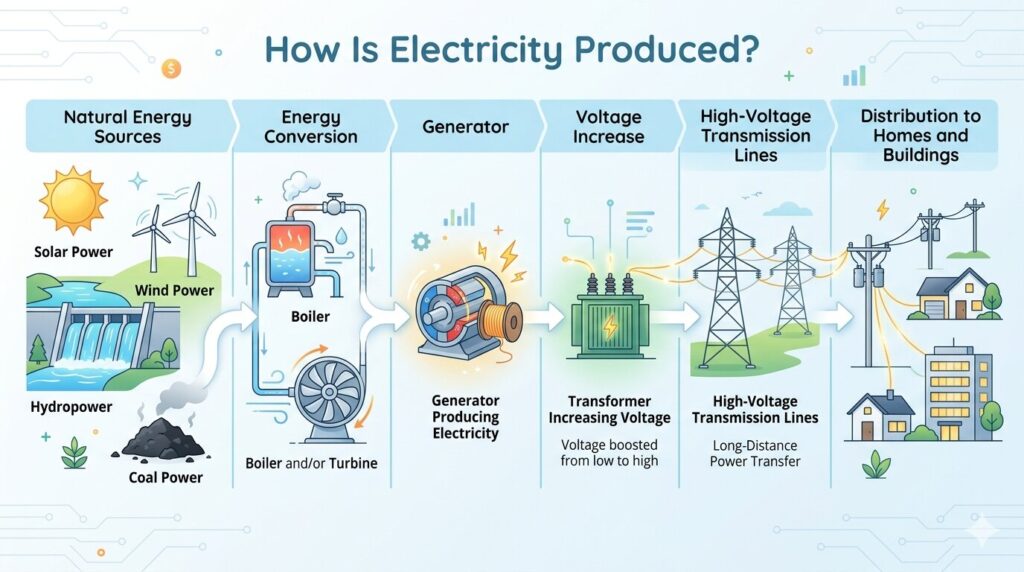
During the course of our daily lives, we cannot do anything without electricity. It is more often than not, even ridiculous to a point that one would not believe it if someone did not make mention of this generation. Having said that, have you ever made efforts to know how the electric power that you get in your house has traveled from power stations? In this blog post let us look at how the electricity travels and the description of all the stages in the course of the way.
How Is Electricity Produced
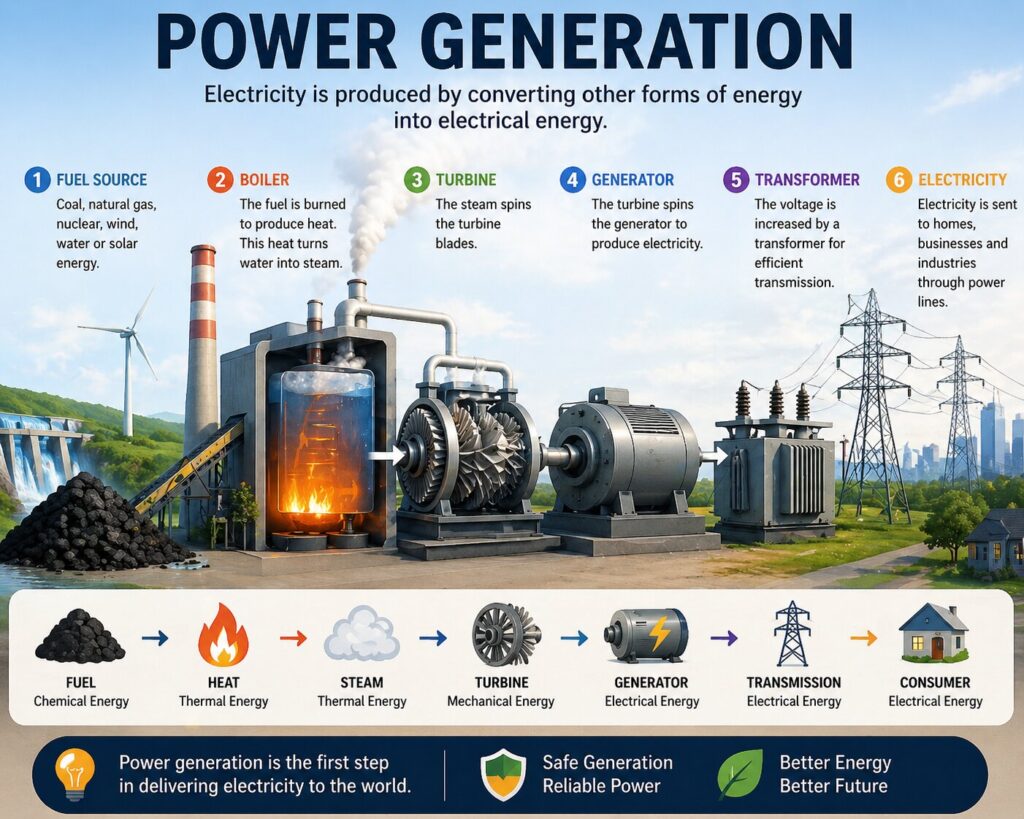
People say that every journey has a starting point, in the case of electric circuits it is at the very beginning stage and from there the electricity reaches the load end. Electricity is produced at power plants and these can rely on many energy sources, which are coal, natural gas, and oil fossil fuel hydrations, nuclear plant operations or renewable energy section solar, wind, hydro or geothermal. There exist different methods for generation of electricity from each one of these energy sources.
- Fossil Fuels: In Fossil Fuel Power Generation, coal or natural gas is burnt to boil water to get steam. This steam spins turbines which are coupled to generators that convert the mechanical energy into electricity.
- Nuclear Energy: In Nuclear power generation, the nuclear fission process heat is used to generate steam that through a turbine generator converts the steam energy to electrical energy.
- Renewable Energy: Energy sources which renew, like solar panels and wind turbines are able to derive energy from the sun and wind respectively to generate electricity and do not pollute the environment by burning fossil fuels. Construction of buildings capable of capturing the sun’s rays is called use of solar panels while construction of blades turned by wind and brought to motion by generators is construction of wind turbines.
Step 1: Transmission to the consumers from the Generation Plants
Once the power is produced, it should then be delivered to the market. In this case, all of the consumers cannot be found next to a power kettle hence electricity should be transferred over long distances. This is achieved through the use of high voltage transmission. Here’s how it works:
- High Voltage: This activity is done to enable minimal wasting of energy which in this case is electricity over long distance. Wherever low losses of energy have to be maintained for every given input low current low voltage supplies must be availed. For a certain power (Watts) there is a certain amount of voltage and a certain amount of current. The more the voltage the less the current for a similar power which also accounts for lower resistance.
- Transmission Lines: The current passes through thick ‘high-tension’ cables strung on supported tall towers. These kinds of cables are used in connecting reversible machinery with electrical power producing stations with high levels of voltage and are confined only during trans-territorial travel.
Step 2: Step-Down Transformation
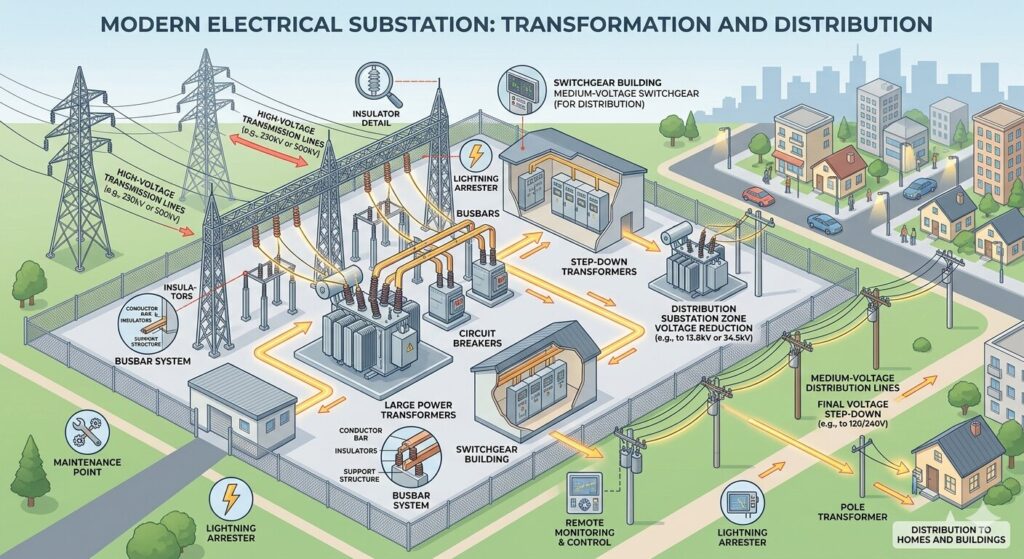
After the electric current comes through the transmission lines, it comes to substations. Here the voltage is brought down to a level which can be used by domestic and industrial consumers.
- Substations: A substation is a location that contains equipment such as transformers that are used to control the flow of electricity. The above stated substation has two functions mainly reducing the electricity that remains from the transmission lines which is usually of a very high voltage in order to facilitate its distribution.
- Step-Down Transformers: This step is critical to this process. They reduce high level (usually high hundreds of thousands of voltage) voltages into low voltage levels (in this case between 4 KVA to 34 KVA) which are acceptable in the dwelling.
Step 3: Distribution to Homes
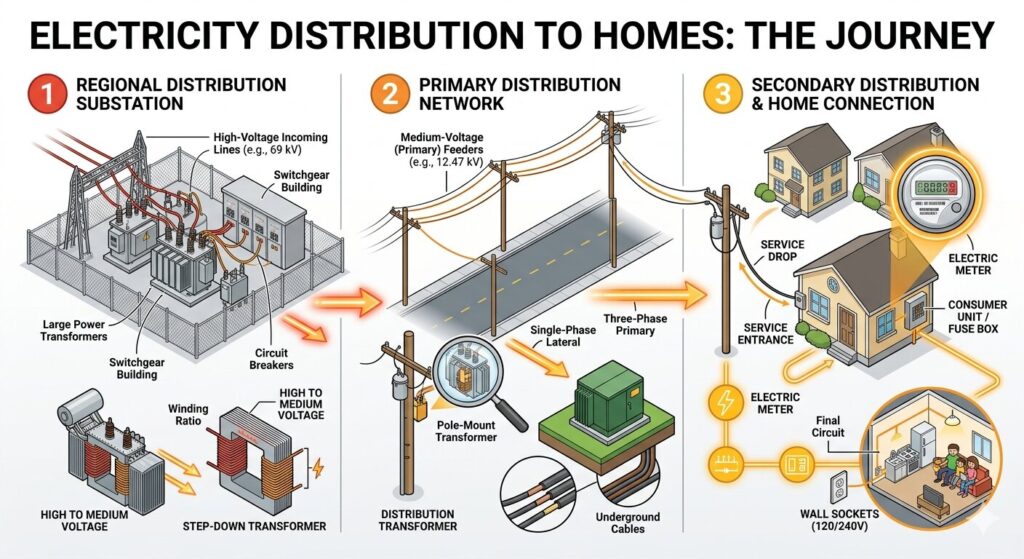
After the electricity has been reduced, it extends to households and businesses. This entails the use of a system of distribution networks.
- Distribution Lines: These lines distribute electricity from substations to different areas within neighborhoods. These lines can either be above ground or submerged into the soil, this is dependent on the type of area and the type of development in place.
- Service Transformers: As electricity is reaching the neighborhood, electricity passes through service transformers that reduce the voltage to 120/240 volts that are safe for users at home.
Step 4: The Final Delivery
The final part of the process involves receiving the electricity into the house.
Service Entrance: In most cases, the service entrance is the very last point of entry of electricity into your house. The power line is connected to your house’s electrical panel at the service entrance.
- Electrical Panel: The electrical panel, or, the same, breaker box, allocates electric energy over the area of the house. It has several circuit breakers meant to save the wires and electrical devices from burning due to overload.
- Home Wiring: After leaving the electrical panel, energy travels through the internal wiring a typical house has and supplies electric power to all the plug points, electric gadgets, and even light fixtures.
Step 5: Metering
A meter is being fixed in your house to measure and record the quantity of power used by the appliances. Its primary function is to determine how much electricity you use over a specified period, and levy charges on consumers based on this.
- Types of Meters: Meters can be classified into two groups which are analog and digital with the former being the older technology. Older generations of meters use mechanical rotation dials while new-age devices display usage on a screen. Smart meters provide live meter readings, helping power guide monitoring improvements and transmitting details to utility companies for better billing practices.
Step 6: Safety Measures
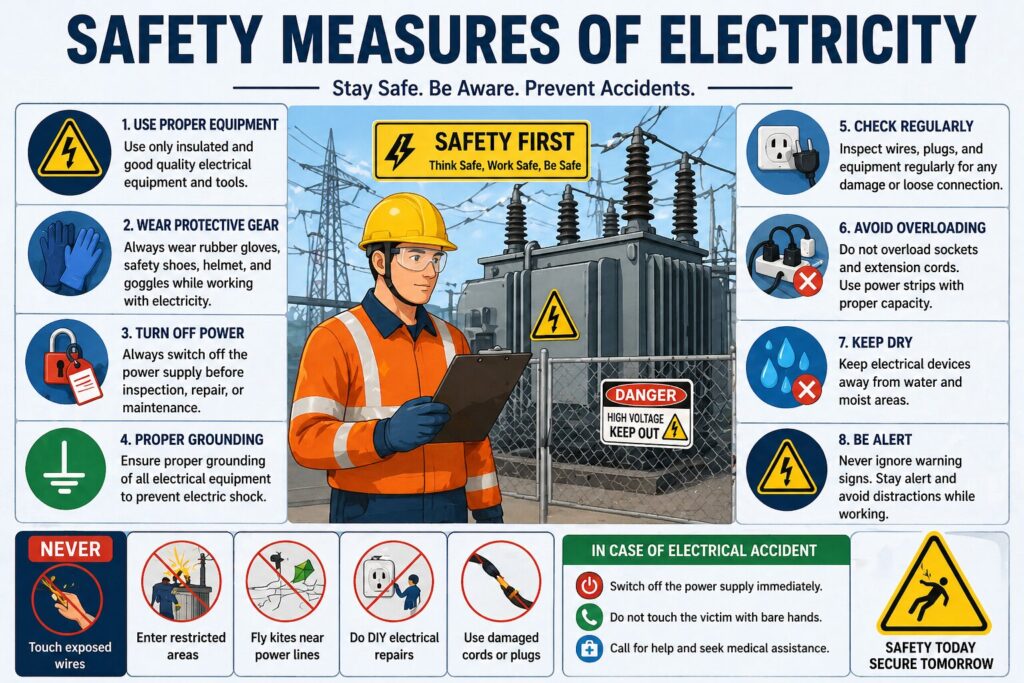
Safety continues to be a priority during this electricity movement in retrospect. There are several precautions that are undertaken to prevent anyone from damage while providing electricity to their residence.
- Circuit Breakers: A Circuit breaker is found within your electrical panel and prevents your household from surges and short circuits. A circuit breaker automatically stops the flow of electricity when it senses that the current is higher than a particular range.
- Grounding: Grounding apparatus enables fault protection and lightning bonding, which diverts excess current safely into the earth.
- Regular Inspections: Regular inspections and maintenance of electrical infrastructure carried out by utility companies are fundamental for their safety and Mg.
Conclusion
Augmenting the winning ways to minimize crude costs would necessitate understanding the various means through which electricity is able to reach one’s zone. Powering homes and enterprise delivery entails a lot of processes which go from generation to transmission then distribution and safety and control.
No matter if it is flipping a switch or plugging a phone or any other electrical gadget into a charger, one gets to appreciate modern engineering and technology when it comes to electricity. In as much as the world seems to be moving towards more sources of energy that are friendly to the environment, It is still good to understand the hard work and creativity that helps in accessing such energy.
Read our latest article about: What Makes Copper the Best Choice for Electrical Wiring?
Frequently Asked Questions (FAQs) on How Electricity Works: From Generation to Your Home (Easy Guide)
Q1. What are basic electrical safety measures at home?
Common electrical safety measures at home include proper use of insulated wires, not overloading sockets, and keeping electrical devices away from water. It is important to unplug devices when they are not in use and to inspect devices for loose wires and plug sockets for loose connections. Sufficient use of circuit breakers and a secure grounding system can prevent and reduce electric shock and fire. It is also important to inform all users in the home, especially children, about the electrical hazards.
Q2. Why is grounding important in electrical systems?
Grounding is important because it provides a safe path of least resistance for the excess current to flow into the earth. It can prevent electric shocks, damage to devices, and electrical fires. When an electrical system on a fault condition is not grounded, the fault condition current is likely to flow through the user or a device. Stabilizing the voltage across a system is also achieved where proper grounding is undertaken. The safety of grounding and electrical system reliability is adequate safety care.
Q3. How can electrical fires be prevented?
Not overloading an electrical outlet, using the best quality electrical devices, and proper installation of an electrical wiring system are key measures that can be undertaken for the prevention of electrical fires. Ensuring circuit breakers are installed along an electrical system and the electrical connections are regularly checked and damaged wires replaced are further measures. The use of devices to break connection when current is too high thus causing an over circuit is also important. Lastly, keeping combustible materials away from electrical devices lowers the risk of fires.
Q4. What is electricity generation and how does it work?
Electricity generation is the process of producing electrical energy from different energy sources such as coal, natural gas, water, wind, and sunlight. In most generation systems, energy is first converted into mechanical energy using turbines, and then into electrical energy using generators. For example, in thermal power generation, fuel is burned to create steam, which spins a turbine connected to a generator. This process ensures that energy from natural resources is transformed into usable electricity for homes, industries, and businesses.
Q5. Why should water be kept away from electrical devices?
Water can easily transfer electric current. If electrical devices are used in a moist environment, then the chances of creating a short are great. In a moist environment, devices will also most likely turn faulty, and in the process, create an electric fire risk. The environment of the devices has to be maintained to be dry. Moreover, the dry environment has to be maintained around hands when devices are operated to ensure devices are used safely.
Q6. What is the danger of overloading sockets?
Overloading sockets is having a lot of devices connected to the outlet. This brings a lot of current that overheats the wiring in the outlet and poses a great risk of creating an electrical fire. Appliances will also easily become faulty and use of a socket in an overloaded state will become a short in and of itself. The lifespan of the appliances will greatly shorten. Overloading sockets also places a lot of current on appliances. There is a lot of power that is beyond the threshold of the devices and appliances. Power strips that provide surge protection and an outlet that is not overloaded greatly help in preventing these problems.
Q7. What are the main types of power generation methods?
Power generation methods are generally divided into two main categories: renewable and non-renewable generation. Renewable generation includes solar, wind, hydroelectric, and geothermal energy, which are sustainable and environmentally friendly. Non-renewable generation includes coal, oil, natural gas, and nuclear energy, which are widely used but have environmental impacts. Each generation method has its own advantages and limitations in terms of cost, efficiency, and environmental impact.
Q8. What are circuit breakers and why are they important?
Circuit breakers are safety devices used in electrical systems and appliances that are designed to stop the flow of electricity by automatically tripping in the event of an overload or short circuit. They can protect people injury and damage from electrical systems and appliances. Circuit breakers are also more user friendly as they are easier to reset compared to fuses, which are more convenient for the electrical systems of today.
Q9. How often should electrical systems be inspected?
Electrical systems are to be inspected often on an annual basis, or on demand in the event of abnormal performance. Abnormal performance can be caused by systems and components malfunctioning, which is indicated by activities such as frequent tripping of the circuit breaker and other systems and components, as well as the presence of burning odors. There are also other indicators, such as flickering lights. Regular inspections will prevent malfunctioning for a period of time.
Q10. Why is electricity generation important in modern life?
Electricity generation is essential for supporting modern society, as it powers homes, industries, transportation systems, and communication networks. Without reliable generation systems, everyday activities such as lighting, heating, cooling, and using electronic devices would not be possible. Efficient generation also supports economic growth and technological development, making it a critical component of infrastructure in every country.
Q11. What should you do in case of an electric shock?
Cut the power in the case of a shock. If of safe distance from electricity leaving the victim in contact shouldn’t be touched. Use a piece of wood or other insulation to pull the victim to safety. Call 911 (in the US) and perform trained first aid. This may include the use of CPR.
Q12. Why should damaged wires be replaced immediately?
Hazard wires leave live conductors exposed. This increases the chance of shock to users and increases the likelihood of a fire. Even a small break results in an insulation failure and can increase the likelihood of a fire due to overheating. To limit the risk of shock or fire, damaged wires should be replaced.
Q13. How does renewable energy generation benefit the environment?
Renewable energy generation helps reduce pollution and greenhouse gas emissions because it relies on natural sources like sunlight, wind, and water. Unlike fossil fuel-based generation, renewable systems do not release harmful gases into the atmosphere. This makes renewable generation a cleaner and more sustainable option, helping to combat climate change and preserve natural resources for future generations.
Q14. What is a short circuit and why is it dangerous?
A short circuit is when a electrical current is directed through a path of low resistance. Due to low resistance the circuit is closed and the current will spike. This spike will cause the wires to potentially combust. To limit the hazards of short circuits, limit the size of the spike. This can be done with a fuse or circuit breaker.
Q15. Why is it important to follow electrical safety signs?
Electrical safety signs indicate high voltage areas or sections that should not be visited. Ignoring electrical safety signs may lead to accidents or injuries. These signs indicate where electrical risks exist, and where special precautions should be maintained when working close to electrical systems.
Q16. What precautions should be taken during rainy weather?
This weather condition should call for appliances outdoors to be left alone. These may lead to certain electrocution. Improper insulation can lead to shocks. Waterproof curtains should be used to encase the cords.
Q17. Why should extension cords be used carefully?
Dangerous risks can be caused by overly abusing extension cords. Cords that are frayed can lead to even further risks as well. Extension cords should be used with care. They should be used as temporary solutions to wiring.
Q18. What is the importance of proper installation of electrical systems?
Electrical systems are installed to use them and have a certain range of wiring to do. This may lead to shocks and burns. To use an installation of electrical systems, one should have a level of control.
Q19. How does regular maintenance improve electrical safety?
This should improve the systems by showing lesser risks. This may lead to unsafe levels of systems. Safety should be a certain threshold. It will be used for shortened systems. It will improve efficiency by showing a certain use in reduced risk.
Q20. Why is professional help important for electrical work?
Safety is a very general term for a very broad field. Professional electricians are safety’s best friends because they carry the tools and the training and experience to handle dangers posed by electrical systems. In the absence of proper training, serious injuries can be sustained due to the dangers posed by just the system. The supplemental knowledge and experience of the professional fulfill the creator’s intent to satisfy the safety standards imposed.